Florida Hospitality Industry Faces Growing Uncertainty After Supreme Court Clears Way for TPS Terminations
Florida’s tourism industry is bracing for difficult decisions after the U.S. Supreme Court cleared the way for the federal government to end Temporary Protected Status (TPS) for thousands of immigrants, leaving employers waiting for detailed guidance on how and when the changes should take effect.
For hotel managers, restaurant owners and hospitality executives across the Sunshine State, the ruling has created more questions than answers.
While the legal battle over TPS has reached a significant milestone, businesses say they cannot act until the Department of Homeland Security and U.S. Citizenship and Immigration Services explain precisely how employers should handle work authorization, employee verification and compliance with federal immigration law.
Industry leaders warn that moving too quickly could expose businesses to legal risk, while waiting too long could also carry consequences.
A Workforce That Keeps Florida Running
Florida’s hospitality sector depends heavily on immigrant workers, particularly in hotels, restaurants, resorts, cleaning services and tourism.
The Florida Restaurant & Lodging Association estimates that more than 93,000 TPS holders live and work in Florida, contributing billions of dollars to the state’s economy each year.
Many have spent years building careers, raising families and supporting businesses that continue to struggle with labour shortages following the pandemic.
Employers say losing experienced staff without a clear transition plan could have significant consequences, particularly during Florida’s busy summer tourism season.
Waiting for Washington
Businesses are now looking to federal agencies for answers.
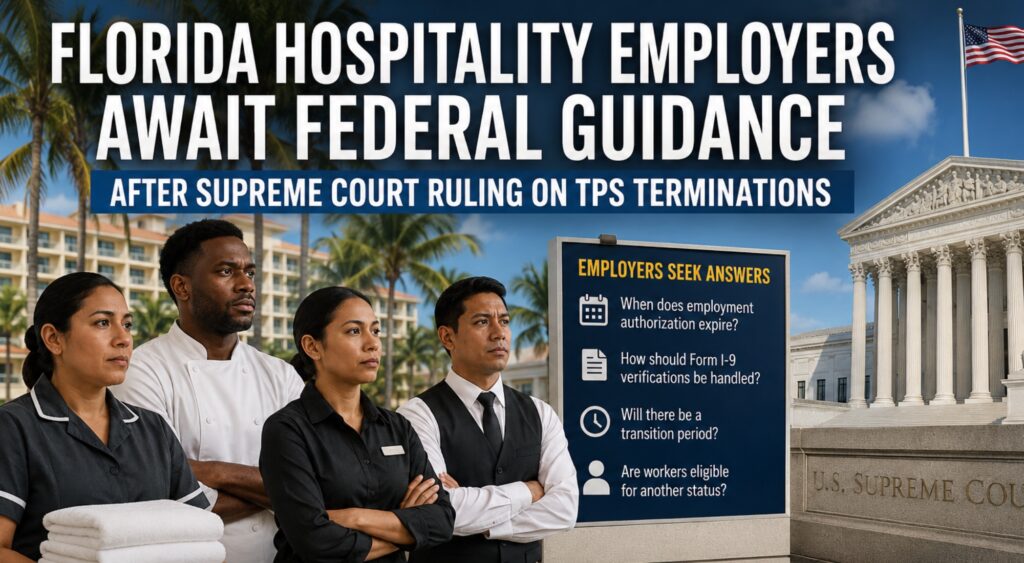
Among the key questions still unresolved are:
When employment authorization officially expires.
Whether existing Employment Authorization Documents remain valid during any transition period.
How employers should complete required Form I-9 employment verification.
Whether affected workers may qualify for another legal immigration status.
Immigration attorneys are advising employers not to make hasty decisions until formal federal guidance is published.
For many companies, the safest course is to prepare employment records for review while monitoring announcements from Washington.
Economic Stakes
The uncertainty comes at a challenging time for Florida’s tourism industry.
Although visitor numbers remain strong, many employers continue to report persistent staffing shortages across hotels, restaurants and visitor attractions.
Business groups argue that a sudden reduction in the available workforce could place additional strain on an industry that remains one of Florida’s largest economic engines.
The debate now moves beyond the courtroom and into the hands of federal agencies responsible for implementing the Supreme Court’s decision.
Until that guidance arrives, employers across Florida are left balancing legal obligations with the practical realities of keeping businesses open and fully staffed.
Whether the transition proves orderly or disruptive may depend less on the court’s ruling than on how quickly Washington provides the clarity businesses say they urgently need.
SEO Keywords
Florida TPS ruling, Supreme Court TPS decision, Florida hospitality workers, Temporary Protected Status Florida, Florida hotels immigration, Florida restaurant workers, TPS employment authorization, DHS TPS guidance, Florida tourism industry, immigration news Florida, Florida business news, Marco Island Naples News
Tags
Florida, Immigration, Supreme Court, Temporary Protected Status, TPS, Hotels, Hospitality, Restaurants, Tourism, Business, Economy, Employment, DHS, USCIS, Florida News