South Florida Coyotes Expanding Diet, Now Feeding on Iguanas and Peacocks, Study Finds
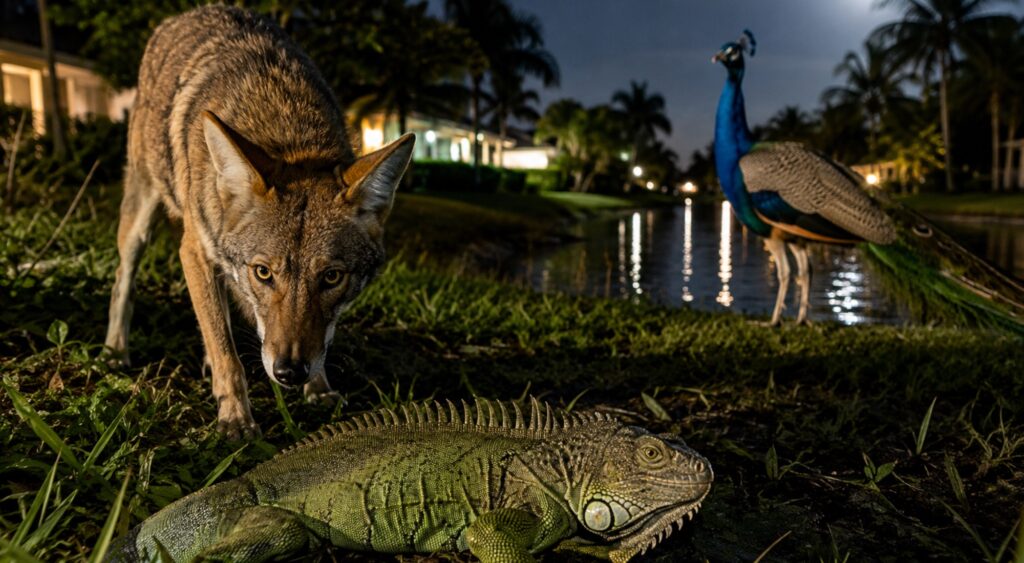
South Florida’s rapidly expanding coyote population is adapting in surprising ways — with a new wildlife study revealing that the animals are now preying on invasive iguanas and even free-roaming peacocks.
Researchers monitoring urban coyote behavior across South Florida say the animals are proving to be highly flexible “opportunistic predators,” adjusting their diets based on what is most available in suburban and coastal environments.
A changing menu in suburban Florida
Traditionally, coyotes in Florida are known for hunting small mammals such as rabbits, rodents, and occasionally scavenging carrion. But new observations show their diet is far broader than previously thought.
According to the study, coyotes have been documented consuming a mix of vegetation, fruit, and a growing number of non-native species — including green iguanas and peafowl.
Both species are well-established in South Florida. Iguanas thrive in canal systems, parks, and residential areas, while peacocks roam freely in several neighborhoods, often introduced decades ago and now living feral populations.
Iguanas become easy targets
Wildlife experts note that iguanas are particularly vulnerable in cooler weather, when their movement slows and they become easier for predators to catch. Their abundance across Miami-Dade and surrounding counties has made them an increasingly common food source for coyotes.
This unexpected predator-prey relationship highlights how invasive species can reshape local food webs — sometimes in unpredictable ways.
Peacocks also on the list
While less common, peacocks have also been recorded as part of the coyote diet. Experts say younger or isolated birds are most at risk, especially in suburban areas where coyotes move through residential green spaces at night.
Urban predators adapting to a new ecosystem
Wildlife officials say coyotes are now present in all 67 Florida counties, a sign of how successfully they have adapted to human-altered environments.
Rather than relying on a single food source, coyotes are increasingly acting as “generalist predators,” taking advantage of whatever is available — from discarded food to invasive reptiles and ornamental birds.
Ecologists say this adaptability helps coyotes thrive, but it also raises questions about their broader impact on Florida’s urban ecosystems, including potential effects on native wildlife and pets.
A complex ecological balance
While coyotes may help control some invasive species populations, wildlife experts caution that their presence is a double-edged sword. Their expanding role in suburban food chains reflects a changing Florida landscape where native and non-native species are increasingly intertwined.
For residents, the findings serve as a reminder of how closely human development, invasive species, and native predators are now connected across South Florida.
South Florida coyotes, Florida wildlife, iguanas Florida, peacocks Florida, invasive species Florida, Miami wildlife, urban coyotes, Florida nature, ecosystem balance, wildlife study Florida, Everglades wildlife, South Florida animals