
Global Natural Disasters This Week
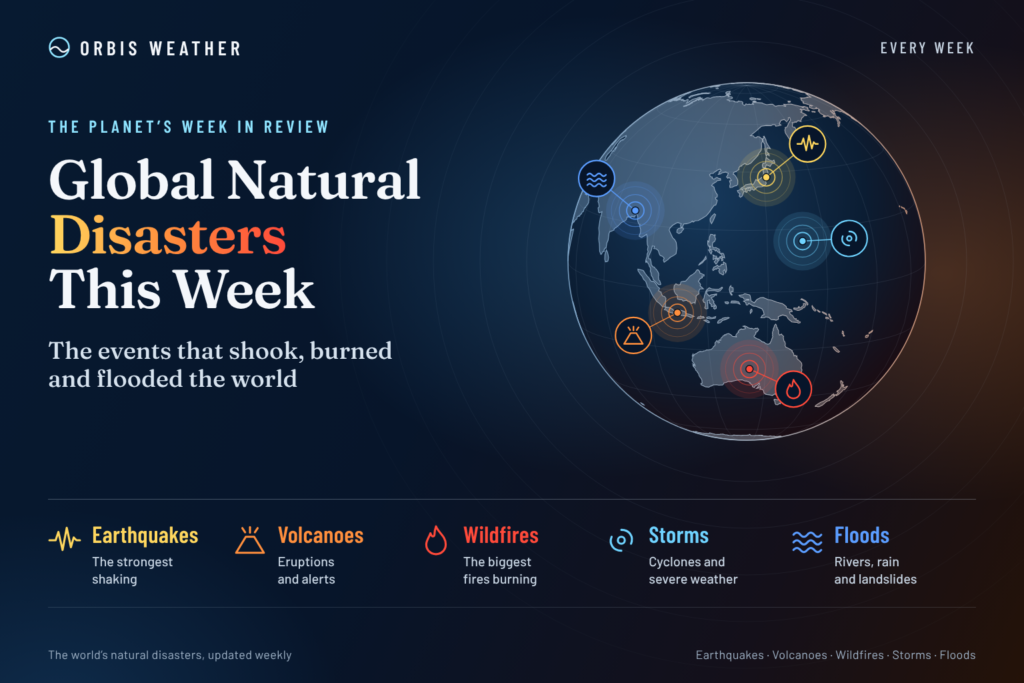
Global Natural Disasters This Week — November 6–13, 2026
Friday, November 13, 2026
Floods, severe storms, earthquakes and volcanic activity dominate global disaster monitoring
From powerful storms and destructive flooding to earthquakes, volcanic unrest and wildfire threats, natural hazards have continued to affect communities across the world during the past seven days.
The week ending November 13 has brought particular attention to flooding risks, severe weather across several continents, and the continuing vulnerability of communities already recovering from earlier disasters.
Global disaster monitoring systems continue to record thousands of weather and geological events. However, these include routine warnings and lower-impact incidents, not just major disasters. The number of active alerts should not be confused with the number of confirmed catastrophes.
This week’s Orbis Weather report examines the major hazard categories, regions of concern and the official sources used to assess their impacts.
1. Canada — Atmospheric rivers bring flooding and evacuations to British Columbia
One of the week’s clearest examples of a damaging natural disaster has unfolded in western Canada, where successive Pacific storms have brought torrential rainfall, rising rivers, flooding and power outages.
British Columbia’s River Forecast Centre issued flood warnings for the South Coast on November 11, including Howe Sound, the Sea-to-Sky corridor and the North Shore Mountains.
Rainfall totals reached 50–150 mm (2–5.9 inches) across parts of Vancouver Island during an earlier reporting period, with additional heavy rain forecast.
By November 12, flooding had prompted evacuation orders and alerts around Pemberton, while residents in areas near Squamish were advised to shelter in place.
On November 13, another threat emerged as elevated coastal water levels and storm surge warnings affected southwestern British Columbia. Some locations had received more than 300 mm (11.8 inches) of rain during the extended storm sequence.
The combination of saturated ground, swollen rivers and additional storms has increased concerns about landslides, road closures and further flooding.
2. Southern Europe — Storm Charles triggers flooding and travel disruption
A powerful weather system named Storm Charles has affected parts of southwestern and southern Europe, bringing destructive rainfall, strong winds and significant transportation disruption.
Madeira experienced wind gusts reaching approximately 136 km/h (85 mph), while rainfall totals reportedly reached 355 mm (14 inches) in 12 hours.
The storm also affected Portugal, Spain and southern France, with flooding around Cannes contributing to rockfalls and road closures.
Air travel suffered major disruption, including reported cancellations at Lisbon and Madrid airports.
As the system moved eastward, heavy rainfall warnings extended toward northern Italy, with additional concerns for the Balkans.
The storm illustrates how intense Mediterranean and Atlantic weather systems can affect multiple countries within a short period, creating simultaneous flood, landslide and transportation hazards.
3. Philippines — Mayon Volcano remains at Alert Level 3
The Philippines continues to face significant volcanic hazards as Mayon Volcano remains in a period of intensified magmatic unrest.
According to the Philippine Institute of Volcanology and Seismology (PHIVOLCS), the volcano displayed minor Strombolian eruptive activity during the week.
The November 12 bulletin recorded 20 volcanic earthquakes, four rockfall signals and sulfur dioxide emissions of 2,036 tonnes per day, based on measurements from November 11.
The November 13 bulletin recorded eight volcanic earthquakes and continued minor Strombolian activity, with sulfur dioxide emissions measured at 2,293 tonnes per day on November 12.
Authorities continue to prohibit entry into the six-kilometer Permanent Danger Zone surrounding the volcano.
Potential hazards include lava flows, falling volcanic rocks, explosive activity, pyroclastic density currents and rainfall-triggered volcanic mudflows known as lahars.
Current assessment: Mayon remains an active volcanic hazard requiring close monitoring, even though a much larger eruption cannot be assumed from the available observations.
4. Global earthquakes — Seismic monitoring continues
Earthquake activity remains an important component of the global natural disaster picture.
The U.S. Geological Survey continues to record earthquakes across tectonically active regions, including Alaska, the Aleutian Islands and the Pacific basin.
On November 12, for example, the USGS recorded a magnitude 4.4 earthquake in Alaska’s Rat Islands region.
However, earthquake magnitude alone does not determine whether an event constitutes a disaster.
A powerful earthquake occurring deep underground or far offshore may cause little damage, while a smaller, shallow earthquake beneath a densely populated city can be devastating.
For this reporting period, a complete verified worldwide earthquake ranking and corresponding casualty assessment were not available from the retrieved records. Consequently, no unsupported claim is being made about the week’s strongest or deadliest earthquake.
Readers can follow the USGS Latest Earthquakes service for updated magnitudes, locations and depths.
5. Gaza — Deadly flooding destroys shelters and threatens displaced families
Heavy rainfall beginning on November 6 caused widespread flooding across the Gaza Strip, damaging temporary shelters, humanitarian facilities and already weakened buildings.
According to a United Nations humanitarian report published November 9, an infant reportedly drowned, while five people were reportedly killed when a sand dune collapsed onto tents.
By November 8, humanitarian organizations had received requests for assistance from more than 26,000 households reporting damaged shelters or belongings.
The United Nations warned that emergency shelter supplies were critically depleted, complicating relief operations.
Save the Children separately estimated that approximately 70,000 tents housing around 350,000 people had been flooded.
Beyond the immediate fatalities and structural damage, prolonged exposure to wet conditions raises the risk of hypothermia, contaminated water and disease outbreaks.
The disaster demonstrates how relatively ordinary seasonal rainfall can produce catastrophic consequences where populations lack secure housing and functioning drainage infrastructure.
6. Iraq — Deadly flash flooding strikes Erbil
Northern Iraq experienced destructive flash flooding on November 7 as intense thunderstorms swept across the region.
The city of Erbil was particularly badly affected, with streets inundated and homes and businesses damaged.
Approximately 80 mm (3.1 inches) of rain reportedly fell, considerably exceeding the approximately 30 mm initially forecast.
Reports indicated two fatalities associated with the flooding.
Flash flooding is particularly dangerous in urban areas where intense rainfall can overwhelm drainage systems within minutes.
The storms also affected neighboring areas of Iran, highlighting the regional extent of the unstable weather.
7. Australia — Destructive thunderstorms strike Queensland and New South Wales
Severe thunderstorms caused widespread disruption across eastern Australia during November 11–12.
In southeastern Queensland, storms produced damaging winds, hail and intense rainfall, bringing down trees and power lines and damaging buildings.
Reports indicated wind gusts reaching approximately 125 km/h (78 mph), with localized rainfall totals of up to 80 mm (3.1 inches) in just 30 minutes.
The Logan area was among the hardest hit, with damage to homes, roads and electricity infrastructure.
The Australian Bureau of Meteorology continued warning of severe thunderstorms and flash flooding risks across southeastern Queensland and northeastern New South Wales.
With catchments already saturated, additional rainfall could produce rapid runoff and localized river flooding.
Meanwhile, parts of northern Queensland experienced extreme heat, illustrating the contrasting weather hazards affecting Australia simultaneously.
Global disaster summary — November 6–13
|
Region |
Major event |
Reported impact |
|---|---|---|
|
Canada |
Atmospheric rivers and flooding |
Evacuations, flood warnings, power disruption |
|
Southern Europe |
Storm Charles |
Flooding, rockfalls, flight cancellations |
|
Philippines |
Mayon volcanic activity |
Alert Level 3, minor eruptions |
|
Gaza |
Heavy rain and flooding |
At least six reported deaths, extensive shelter damage |
|
Iraq |
Erbil flash floods |
Two reported deaths, urban flooding |
|
Australia |
Severe thunderstorms |
Property damage, power outages, flash-flood threats |
|
Global |
Earthquakes |
Ongoing seismic activity; no verified weekly disaster total |
Figures reflect reporting available by November 13, 2026. Casualty figures are preliminary, and the table is a selected roundup rather than an exhaustive global disaster inventory.
What to watch over the coming days
Several regions require continued monitoring.
In western Canada, further Pacific storms and elevated coastal water levels could complicate recovery efforts.
Across southern Europe, additional rainfall could worsen flooding and landslide risks, particularly in areas already saturated by Storm Charles.
In the Philippines, Mayon’s continuing unrest means residents must observe official exclusion zones and remain prepared for changes in volcanic activity.
Australia faces further thunderstorm risks, while communities affected by flooding in Gaza and Iraq remain vulnerable to additional rainfall.
Why natural disasters remain a growing concern
The consequences of natural hazards depend on far more than the strength of an individual storm or earthquake.
Population density, infrastructure, emergency preparedness, poverty, environmental degradation and the availability of early warnings all influence the eventual human toll.
A storm bringing 100 mm of rain may cause limited disruption in one location but devastating flooding in another.
Climate change is increasing the likelihood or intensity of some weather extremes, particularly heavy precipitation and heatwaves. However, not every disaster can be attributed directly to climate change, and earthquakes and volcanic eruptions are driven primarily by geological processes.
Understanding these differences is essential for accurate disaster reporting.
Official sources and disaster monitoring
-
Global Disaster Alert and Coordination System (GDACS) — international disaster alerts and impact assessments.
-
U.S. Geological Survey (USGS) — earthquake monitoring.
-
Smithsonian Global Volcanism Program — volcanic activity reporting.
-
Australian Bureau of Meteorology — Australian severe weather warnings.
-
PHIVOLCS — Philippine volcanic and earthquake hazards.
-
United Nations OCHA — humanitarian disaster assessments.
-
World Meteorological Organization — international meteorological information.
Final assessment
The week of November 6–13, 2026, has demonstrated the diversity of natural hazards affecting the world.
Flooding has produced some of the most serious documented humanitarian consequences, particularly in Gaza and Iraq. British Columbia has experienced dangerous atmospheric rivers, southern Europe has endured a damaging storm, and eastern Australia has faced destructive thunderstorms.
Meanwhile, volcanic activity at Mayon remains a significant concern for communities in the Philippines.
The common theme is vulnerability: severe natural events become disasters when they threaten lives, homes, essential infrastructure and communities with limited capacity to respond.