





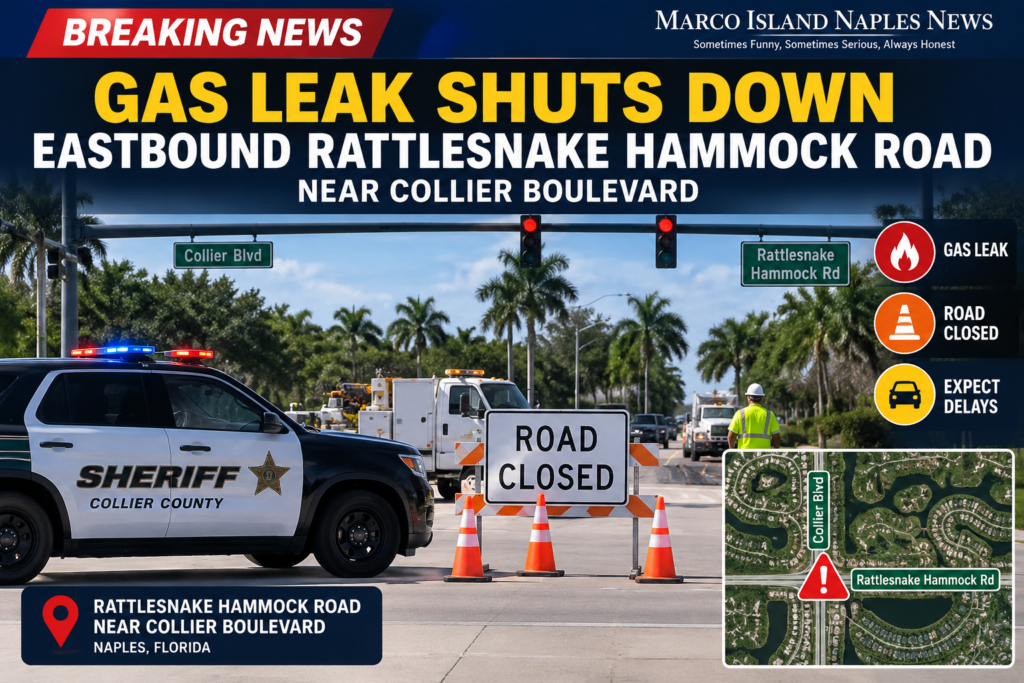

🚨 Gas Leak Shuts Down Eastbound Rattlesnake Hammock Road Near Collier Boulevard
COLLIER COUNTY, Fla. — September 17, 2026 — A gas leak has shut down all eastbound lanes of Rattlesnake Hammock Road just east of Collier Boulevard in East Naples, creating traffic problems along one of the area’s busiest corridors.
The Collier County Sheriff’s Office issued a traffic alert Thursday afternoon reporting that the eastbound lanes were closed because of the leak. The closure was reported at approximately 1:30 p.m.
🚧 Deputies and Gas Crews on Scene
Sheriff’s deputies were dispatched to the area to assist with traffic control while gas company crews worked to locate and repair the problem.
Eastbound traffic is unable to travel through the affected section of Rattlesnake Hammock Road, and motorists should avoid the area if possible and use alternate routes.
The closure is particularly significant because the intersection of Rattlesnake Hammock Road and Collier Boulevardserves as a major connection for East Naples, Lely and communities farther south in Collier County.
⚠️ Cause of Leak Not Yet Announced
As of Thursday evening, officials had not publicly announced what caused the gas leak or provided an estimated time for reopening the eastbound lanes. Available reports also did not identify any injuries or announce an evacuation order.
Gas leaks can require road closures while crews determine the source of the leak, shut down or isolate the affected line and verify that the surrounding area is safe.
🚗 Expect Traffic Delays
Drivers traveling through the area should expect delays, particularly around:
Rattlesnake Hammock Road
Collier Boulevard
Nearby East Naples and Lely communities
Motorists heading east on Rattlesnake Hammock Road should consider an alternate route until authorities announce that the roadway has reopened.
🔴 Developing Story
This remains a developing situation.
Marco Island Naples News will update this story when additional information becomes available regarding the cause of the leak, repairs and reopening of Rattlesnake Hammock Road.
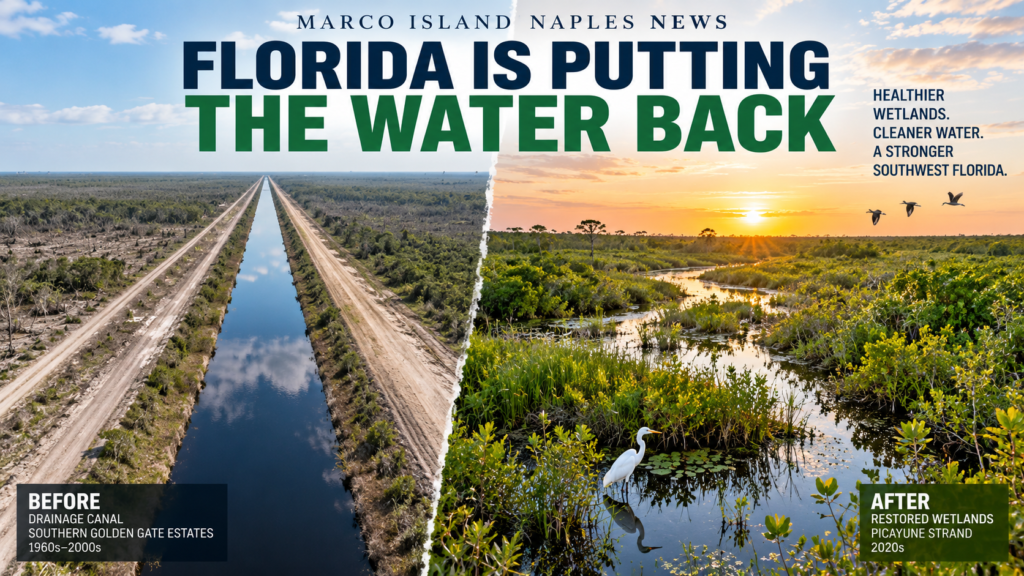
Florida Spent Decades Draining the Everglades — Now Collier County Is Putting the Water Back
COLLIER COUNTY, Fla. — For generations, Florida engineers faced one overriding challenge: how do you get rid of all this water?
They dug canals. They built roads and levees. They installed pumps. And across South Florida, enormous areas of wetlands were drained to make room for agriculture and development.
Now, in a remarkable reversal, engineers have spent years doing almost the opposite.
They’re plugging canals, tearing out old roads and trying to make water move slowly across the landscape again.
And one of the biggest examples of this environmental U-turn is right here in Collier County.
🌿 The Failed Development That Changed Southwest Florida
The story begins in the 1960s with an ambitious development called Southern Golden Gate Estates.
Developers carved a massive grid of roads and drainage canals through more than 85 square miles of wetlands between what are now Alligator Alley and Tamiami Trail.
The plan was enormous residential development.
Much of it never happened.
But the roads and canals remained.
Those canals continued doing exactly what they had been designed to do: drain water away from the wetlands.
Over time, the drainage altered groundwater levels, wetland habitat and the natural movement of freshwater toward the Ten Thousand Islands and nearby coastal ecosystems.
The area eventually became the focus of one of Southwest Florida’s largest environmental restoration projects.
💧 The Picayune Strand Restoration Project
The Picayune Strand Restoration Project covers approximately 55,000 acres of wetlands and uplands in Collier County.
The project is part of the larger Comprehensive Everglades Restoration Plan.
Its goal sounds surprisingly simple:
Put the water back where nature originally intended it to go.
Getting there required a huge engineering effort.
According to the South Florida Water Management District and U.S. Army Corps of Engineers, the project involved removing roughly 260 miles of old roads, plugging about 48 miles of canals and constructing three major pump stations.
After decades of construction and restoration work, officials celebrated completion of the project in January 2026 at the Miller Pump Station in Naples.
In other words, something remarkable has happened just inland from Naples and Marco Island:
Florida has deliberately dismantled part of the drainage system that earlier generations spent enormous effort constructing.
🌊 Why Plug a Canal?
A canal moves water efficiently.
That’s exactly the problem when you’re trying to restore a wetland.
Before extensive drainage, rainwater moved gradually through Southwest Florida’s wetlands. Instead of immediately disappearing down a canal, water spread across the landscape in shallow sheets.
Hydrologists call this sheet flow.
That slow movement of freshwater helps sustain wetlands, recharge groundwater and provide habitat for native wildlife.
Canals can short-circuit that system.
Rather than water slowly spreading through wetlands, canals can collect it and rapidly carry it away.
So engineers have plugged sections of the old canals to reduce that drainage.
The U.S. Army Corps of Engineers says the restoration is designed to reestablish natural water flow across an area that had been dramatically altered by the failed development.
🐊 What Does This Have to Do With Naples and Marco Island?
Quite a lot.
Picayune Strand sits immediately upstream of some of Southwest Florida’s most environmentally important areas.
Restoring the wetlands is expected to improve water movement toward Collier-Seminole State Park, the Ten Thousand Islands National Wildlife Refuge and the Rookery Bay National Estuarine Research Reserve.
That makes this more than an Everglades story.
It’s a Collier County water story.
Restoring natural hydrology can improve groundwater recharge and reduce the unnatural concentration of freshwater flowing through drainage canals into coastal estuaries.
The project is also intended to help protect the eastern Golden Gate wellfield serving Naples by improving groundwater recharge.
🐆 Wildlife Gets Its Wetlands Back
There is another major beneficiary: wildlife.
Picayune Strand provides habitat for numerous native species, including the Florida panther.
Restoring seasonal wetlands creates healthier habitat for fish, birds, reptiles and mammals while reconnecting ecosystems fragmented by decades of roads and drainage infrastructure.
The South Florida Water Management District says anticipated benefits include improved wildlife habitat, increased groundwater levels, reduced drainage of neighboring ecosystems, improved aquifer recharge and reduced saltwater intrusion.
There’s even a manatee component.
Changing flows from the Faka Union Canal required construction of a special manatee refuge, because manatees had become accustomed to warm-water conditions associated with canal flows.
It demonstrates just how complicated reversing decades of human alteration can become.
🚜 Hundreds of Miles of Roads Removed
Perhaps the most visually astonishing part of the project isn’t the canals.
It’s the roads.
Satellite imagery of Southern Golden Gate Estates once showed an enormous geometric grid sliced through the wilderness.
Much of that grid has now been dismantled.
More than 260 miles of roads were removed, along with dozens of miles of old logging tram roads.
Removing them matters because roads can behave like miniature dams, blocking water from moving naturally across wetlands.
The objective is to reconnect the landscape so water can once again spread through the ecosystem instead of being confined by human-built barriers.
🌀 But Florida Isn’t Getting Rid of All Its Canals
That’s an important distinction.
South Florida still depends heavily on canals, levees, pumps and water-control structures.
They protect homes and businesses from flooding, provide water supplies and help manage enormous amounts of rainfall during Florida’s wet season and tropical storms.
The Picayune Strand project therefore isn’t simply about “getting rid of canals.”
It is about removing or modifying infrastructure where drainage caused ecological damage while maintaining flood protection for surrounding developed and agricultural areas.
Three large pump stations and a protection levee are part of the restoration system for exactly that reason.
Engineers aren’t abandoning water management.
They’re redesigning it.
🌎 Florida’s Great Environmental Reversal
There is something extraordinary about the history behind this project.
A century ago, draining wetlands was widely considered progress.
Water was viewed as something that needed to be removed so land could become useful.
Today we understand that those wetlands were doing valuable work themselves — storing water, supporting wildlife, replenishing aquifers and maintaining the delicate balance between freshwater and saltwater along Florida’s coast.
Picayune Strand may be one of the clearest examples anywhere in Florida of that change in thinking.
We dug canals to drain the land.
We built roads across the wetlands.
We changed where the water went.
And decades later, after seeing the consequences, we spent years taking much of it apart.
In January 2026, the restoration reached a major milestone when federal and state officials officially celebrated completion of the 55,000-acre Picayune Strand Restoration Project.
For residents of Marco Island and Naples, this isn’t some distant Everglades restoration project happening on the other side of Florida.
It’s happening in our backyard.
And after more than half a century, part of Collier County is finally being allowed to behave like a wetland again.
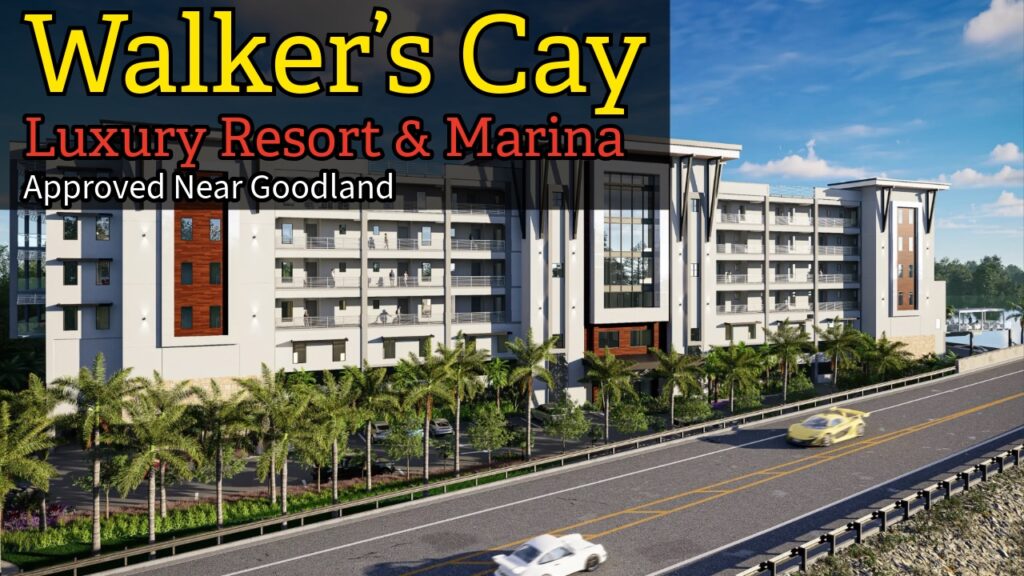
Walker’s Cay Luxury Resort & Marina Approved Near Goodland
Developer Promises High-End Waterfront Resort With Restaurant, Spa, Marina and Luxury Amenities
MARCO ISLAND, Fla. — Walker’s Cay Luxury Resort & Marina isn’t being envisioned as simply another hotel near Goodland. Promotional material for the development describes an upscale waterfront destination combining privately owned accommodations, boating, dining, wellness and resort amenities in one of Marco Island’s most distinctive waterfront locations.
The developer describes Walker’s Cay as offering “a luxury experience at every turn,” with expansive accommodations, custom-designed interiors and a collection of amenities intended to position the property at the upper end of Marco Island’s hospitality market.
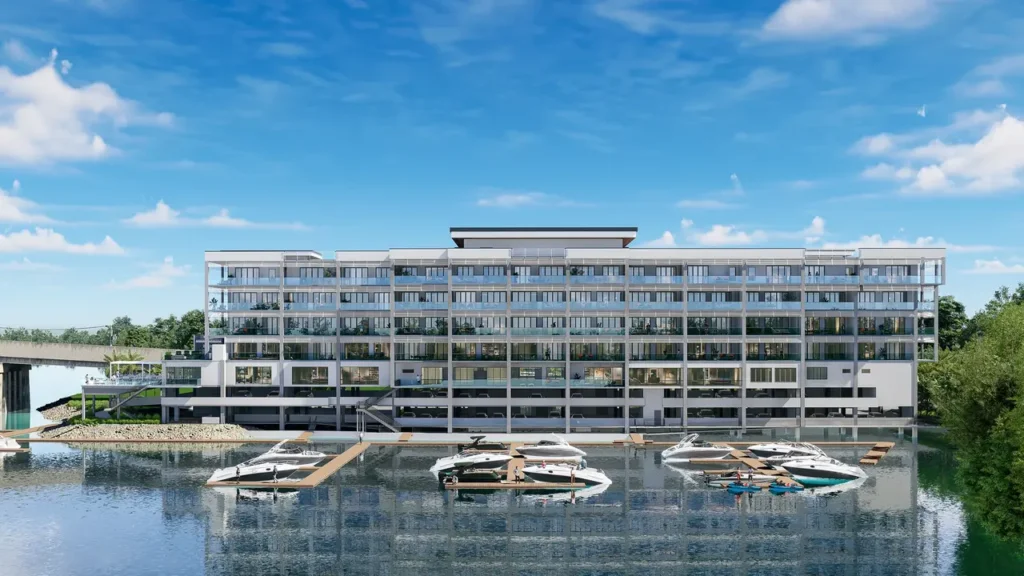
🏨 Luxury Condo-Hotel Accommodations
Walker’s Cay is planned as an intimate condominium-hotel rather than a sprawling beachfront resort.
Promotional material describes an exclusive collection of luxury residences featuring expansive layouts and custom-designed interiors.
There is, however, a discrepancy in the developer’s promotional language. One section describes 45 residences, while another refers to 42 residences. The project’s approved development plans have been reported as containing 45 condominium-hotel units, so the final number should be confirmed as the development progresses.
The distinction between residences and permanent residences is also important.
Although the units are being marketed using residential-style language, the project’s city approval prohibits the property from being used as a permanent residential development. Walker’s Cay is intended to operate as a commercial condominium hotel.
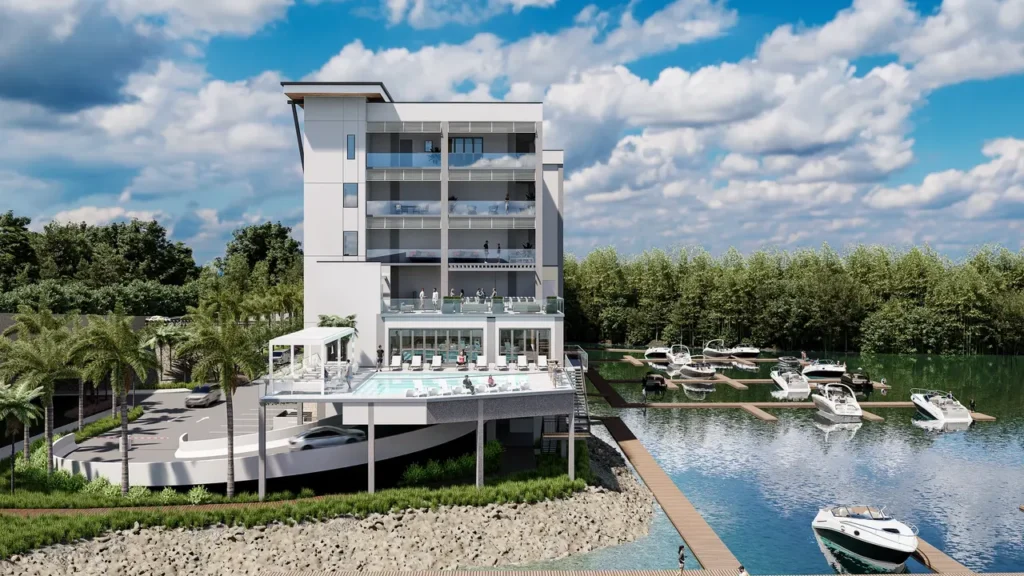
🍽️ Waterfront Restaurant & Bar
A major attraction will be the property’s planned restaurant and bar.
According to promotional material, the restaurant will emphasize coastal cuisine, including locally sourced seafood, seasonal ingredients and fresh produce.
Indoor and outdoor dining areas are planned, taking advantage of the property’s waterfront location.
The developer envisions the restaurant as a destination not only for hotel guests but for people looking for upscale lunches, dinners and special occasions.
That could make the restaurant one of the project’s most visible additions for Marco Island and Goodland residents who may never stay at the hotel but could visit the property for dining and entertainment.
🌴 Outdoor Waterfront Dining
Outdoor dining is also being promoted as a significant part of the Walker’s Cay experience.
Plans envision an upscale open-air setting incorporating waterfront views, sea breezes and sunset dining.
While some of the promotional material uses imagery more commonly associated with an oceanfront or beachfront resort, Walker’s Cay itself is a marina-front property near Goodland rather than a Gulf beachfront hotel.
Its waterfront setting nevertheless provides direct access to the boating waters surrounding Marco Island and the Ten Thousand Islands.

⚓ Marina Steps From the Resort
For boaters, the marina could be the defining feature of Walker’s Cay.
The approved development calls for approximately 45 marina slips, providing guests and boaters with direct waterfront access.
The developer promotes the ability for guests to walk from their accommodations directly to the marina and board their vessels.
The location could be particularly attractive for recreational boaters and anglers because of its proximity to the maze of waterways surrounding the Ten Thousand Islands and relatively quick access toward the Gulf of Mexico.
The development is also expected to include a ship store and charter or tour boat operations.
💆 Full Spa & Wellness Center
Walker’s Cay is also being marketed as a wellness destination.
Plans described by the developer include an on-site Spa and Wellness Center featuring saunas, steam rooms, treatment rooms and jetted spas.
A fitness complex is expected to complement the spa with modern cardio and strength-training equipment, a dedicated free-weight area, flexible fitness space and a yoga studio.
Together, the amenities suggest Walker’s Cay is targeting the luxury-resort market rather than functioning primarily as a marina with hotel rooms attached.

🏊 Resort Pool, Cabanas and Sunset Views
A resort-style swimming pool and sundeck are another centerpiece of the project.
The developer’s vision includes poolside service, private or semi-private cabanas and areas designed for guests to relax outdoors throughout the day.
The property’s western Florida location also means sunsets are being incorporated heavily into the resort’s marketing.
🛎️ More Than a Place to Sleep
Other amenities proposed or promoted for Walker’s Cay include:
- Concierge service
- Valet parking
- Covered parking
- Room service
- Housekeeping
- Fitness facilities
- Yoga studio
- Spa and wellness facilities
- Swimming pool and sundeck
- Cabanas
- Indoor and outdoor dining
- Restaurant and bar
- Marina
- Ship store
- Charter and tour boat operations
Taken together, the amenities paint a clearer picture of what Walker’s Cay is intended to become: a boutique luxury waterfront resort built around boating, dining and wellness.
🏗️ Luxury Marketing Could Renew Residential Questions
The promotional language may also attract additional attention from residents.
Walker’s Cay marketing repeatedly refers to the condo-hotel units as “residences” and emphasizes luxury living, private accommodations and direct marina access.
That doesn’t necessarily mean the property will operate as permanent housing. Condo-hotels routinely use residential terminology when marketing individually owned units.
But in this case, the distinction matters because whether Walker’s Cay could effectively become a residential condominium development was already a significant issue during Marco Island’s review of the project.
City approval specifically prohibits residential use.
As the project moves toward construction and eventual sales, residents and city officials will likely continue watching how the units are marketed, sold and ultimately operated.
🌊 A Very Different Waterfront Is Coming
If the finished resort resembles the vision presented in its promotional material, the transformation of the old marina property will be substantial.
A site once associated with Moran’s Barge Marina and, before that, Ship Ahoy could become home to a multi-story boutique luxury resort featuring a marina, upscale restaurant, spa, fitness center, swimming pool and waterfront entertainment.
For supporters, Walker’s Cay represents investment in a deteriorated waterfront property and the return of an active marina.
For critics, it represents another example of increasingly upscale and intensive development changing the character of Marco Island.
Either way, the project has the potential to become one of the most recognizable developments along the Marco Island-Goodland waterfront.
And with only a relatively small number of hotel units combined with extensive resort amenities, Walker’s Cay clearly isn’t aiming for the mass-market hotel business.
It’s aiming for luxury.

🚗 Naples Now Has $1.2 Million Condos — For Your Cars
Because apparently your Lamborghini has suffered enough
NAPLES, Fla. — If you thought the Naples real estate market couldn’t possibly get any more Naples, we have wonderful news.
You can now spend up to $1.2 million on a condo for your cars.
Yes. The cars.
Welcome to Prima Auto Condos, where luxury vehicles can finally escape the indignity of living in an ordinary garage like some sort of Toyota Corolla.
Units at the Naples development range from approximately 1,750 to 2,125 square feet — meaning your Ferrari may soon have more living space than many actual humans.
And these aren’t exactly your grandfather’s garages.
The units reportedly feature 18-foot ceilings, climate control, keypad and card-reader access, security cameras and alarm systems.
The largest units have enough room for up to seven vehicles.
Because everyone knows the greatest crisis facing Southwest Florida today is finding suitable housing for the seventh Porsche.
🏠 Sorry, Humans — This One’s for the Bentley
At prices reaching $1.2 million, Prima Auto Condos provide a fascinating glimpse into the Naples luxury economy.
For approximately the price of an actual house in many parts of America, your automobile can enjoy climate-controlled accommodations protected by electronic access and security cameras.
Meanwhile, your neighbor’s 2008 Honda Civic remains outside.
In the sun.
Like an animal.
🚘 Finally, Cars Can Experience the Naples Lifestyle
The concept caters to collectors and enthusiasts who need secure, upscale storage for exotic cars, classics and other valuable vehicles.
And to be fair, anyone owning several six-figure automobiles probably doesn’t want to leave them squeezed between a lawn mower and three boxes of Christmas decorations.
These aren’t merely parking spaces. They’re essentially private automotive showrooms where owners can store and display their collections.
Which raises an important question:
At what point does the garage become nicer than your house?
In Naples, apparently somewhere around $1.2 million.
💰 The Most Naples Thing Ever?
Southwest Florida has never been particularly shy about luxury.
We have waterfront mansions, superyachts, exotic cars, private clubs and homes where the guest bathroom probably has a better Zillow estimate than most Midwestern houses.
But luxury condominiums specifically designed for automobiles may represent a new milestone.
Imagine explaining this purchase to someone elsewhere:
“I bought a condo in Naples.”
“Oh, congratulations! Are you moving there?”
“No.”
“Investment property?”
“No.”
“Vacation home?”
“No. My McLaren lives there.”
Perfectly normal.
🏎️ Seven Cars, One Very Happy Garage
With space for as many as seven cars in the largest units, Prima Auto Condos could appeal to serious collectors who have encountered that classic Southwest Florida dilemma:
Too many exotic cars, not enough climate-controlled real estate.
It’s a problem most of us didn’t realize existed.
But Naples found a solution.
So the next time someone tells you Southwest Florida has an affordable-housing problem, remember this:
Somewhere in Naples, seven cars may soon be sharing a $1.2 million condo.
And unlike the rest of us, they probably don’t even have an HOA meeting to attend.
Marco Island Naples News
Sometimes Funny. Sometimes Serious. Always Honest.
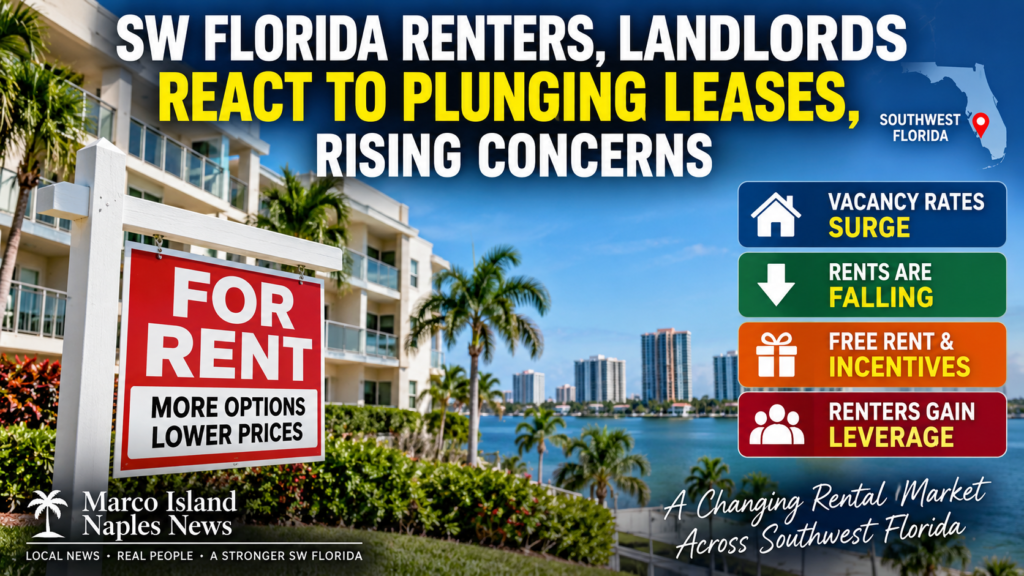
SW Florida Renters, Landlords React to Plunging Leases, Rising Concerns
SOUTHWEST FLORIDA — After years of soaring rents, bidding wars and limited availability, Southwest Florida’s rental market has swung sharply in the opposite direction.
Apartments that once disappeared almost as soon as they were listed are now sitting vacant, forcing some landlords to cut prices, offer free rent and add incentives to attract tenants.
For renters, it could be the best negotiating environment Southwest Florida has seen in years. For landlords and apartment investors, however, the shift is creating growing financial concerns.
🏢 Vacancy Rates Surge
The biggest problem appears to be an abundance of available apartments.
Commercial real estate professionals told WGCU that data from CoStar Analytics puts vacancy around 20% in parts of the Southwest Florida market, while Chase Mayhugh, president of Mayhugh Commercial Advisors, believes the true figure could be approaching 30% in some areas because not every apartment community fully reports vacancies.
That is an enormous change for a region that spent much of the past decade trying to build enough housing for its rapidly growing population.
Other estimates illustrate just how widespread the problem has become. Apartments.com reported summer 2026 multifamily vacancy rates of approximately 18.6% in Fort Myers, 17.4% in Naples and 23.1% in Cape Coral, compared with a national rate of about 8.2%.
In other words, in Cape Coral, the estimate suggests nearly one out of every four apartments is vacant.
💰 Rents Are Falling in Lee County
The increased competition is putting substantial downward pressure on rents.
Realtor.com data for August shows the median Lee County rent at about $2,000 per month, down 11.1% from a year earlier. The county had roughly 5,176 rental properties listed.
Apartment List’s September report also shows weakness in Fort Myers. Its measure of median rent stands at $1,158, down 6.3% year over year. Different rental datasets use different methodologies, so their dollar figures should not be directly compared, but they point in the same direction: rents have been falling.
CoStar analysis published in August put the average Fort Myers apartment asking rent at about $1,750, down 4.3% from a year earlier.
🎁 Free Rent, Lower Fees and Even Gift Cards
Landlords aren’t just lowering advertised rents.
Some apartment communities are offering significant concessions to get renters through the door.
In Fort Myers, incentives at some newer developments have included multiple months of free rent, reduced fees and other move-in specials.
Mayhugh told WGCU that renters should consider negotiating because some landlords are willing to lower rents, offer free-rent periods or even provide Publix gift cards to secure a lease.
For someone whose lease is about to expire, that changes the equation considerably.
Instead of automatically accepting a renewal increase, renters may now have leverage to ask their current landlord for a better deal—or shop competing properties.
🏗️ How Did Southwest Florida Get Here?
Ironically, today’s problem grew partly out of yesterday’s housing shortage.
Developers responded to years of population growth and insufficient apartment inventory by building thousands of units across Southwest Florida.
Eventually, supply began arriving faster than renters could absorb it.
The Fort Myers market has now experienced rent declines for more than three years as new apartment construction expanded available inventory.
A mid-year analysis of the Naples multifamily market similarly found that new supply has been outpacing absorption, pushing effective rents lower even though Collier County remains an expensive place to live.
🏠 Landlords Face a Different Reality
The situation isn’t nearly as enjoyable from the property owner’s side of the lease.
Southwest Florida landlords have been dealing with a difficult combination of lower rents, greater competition, insurance costs, maintenance expenses and softer property values in some areas.
And an empty rental can quickly become more expensive than accepting a lower monthly rent.
Local property-management analysis suggests some parts of the market may finally be showing early signs of stabilization. Three-bedroom rental inventory has declined in Fort Myers and Cape Coral compared with last year, although lower-priced rentals remain highly competitive.
That means the market isn’t moving uniformly.
A luxury Naples condominium, Cape Coral single-family house and Fort Myers apartment can experience dramatically different demand even though they’re all considered part of Southwest Florida.
🌴 Naples and Collier County Are More Complicated
The picture also changes when you cross from Lee County into Collier County.
Realtor.com currently reports a $5,500 countywide median rental listing price in Collier County, up 4.76% year over year. But that number includes a market with a large inventory of expensive and seasonal properties, including Naples and Marco Island, making it very different from the conventional apartment market.
Meanwhile, multifamily research indicates Naples apartment owners are also dealing with increased supply, declining effective rents and concessions.
So falling apartment rents shouldn’t be confused with Southwest Florida suddenly becoming inexpensive.
For many workers and families, housing remains one of the region’s largest expenses.
📉 From Landlord’s Market to Renter’s Market
Only a few years ago, Southwest Florida renters frequently faced limited choices and rapidly increasing prices.
Today, the balance of power has shifted.
Renters increasingly have the ability to compare multiple properties, negotiate rents, request waived fees and look for move-in incentives.
Landlords, meanwhile, must decide whether to hold firm on price and risk leaving a property empty—or reduce the rent enough to attract a tenant.
The Bottom Line
Southwest Florida isn’t running out of renters.
It may simply have more rental housing than the current market can absorb at the prices landlords became accustomed to charging.
Construction is beginning to slow, which could eventually allow population growth and household formation to catch up with available inventory.
Until then, renters appear to have something they haven’t enjoyed much of in Southwest Florida in recent years:
Leverage.
And for landlords waiting for the rental boom days to return, 2026 is delivering a much different message:
Price matters again.

Update Sep 7.
5 people killed, 5 injured after Amazon cargo plane overruns runway at MIA
🚨 BREAKING: Amazon Cargo Plane Overruns Runway at Miami International Airport, Strikes Vehicles and Catches Fire
MIAMI, Fla. — September 6, 2026 — A dramatic aircraft emergency unfolded at Miami International Airport Sunday afternoon after an Amazon-branded cargo plane overran a runway, struck vehicles and caught fire, sending thick black smoke into the sky and temporarily bringing airport operations to a halt.
The Federal Aviation Administration said 21 Air Flight 7598, a Boeing 767-300 cargo aircraft operating for Amazon’s air delivery network, overran the runway after landing at approximately 2 p.m. Sunday. The flight had arrived from Luis Muñoz Marín International Airport in San Juan, Puerto Rico.
✈️ Plane Goes Beyond Runway
Miami International Airport said Prime Air Flight 7598 overran the airport’s diagonal runway and became disabled near the northwest end of the airport.
The emergency quickly escalated after the aircraft continued beyond the runway area. Miami-Dade Fire Rescue reported that several vehicles were struck near Northwest 42nd Avenue. Images and video from the scene showed flames and a massive plume of dark smoke rising from the aircraft.
More than 60 Miami-Dade Fire Rescue units were dispatched as firefighters worked to bring the blaze under control and search the area for victims.
🚑 Multiple Injuries Reported
Miami-Dade Fire Rescue told local media that multiple people were injured, although officials had not immediately provided details about the number of patients or the severity of their injuries. Early reports regarding casualties remain subject to change as emergency crews continue their work.
There was also no immediate official information regarding the condition of the aircraft’s crew.
🛑 Miami International Airport Operations Disrupted
The crash caused major disruption at one of Florida’s busiest airports.
Airport officials initially reported that all runways and taxiways were closed, with a ground stop in effect as emergency crews responded to the disabled aircraft.
The disruption could have a ripple effect on flights across Florida and the United States, including travelers from Southwest Florida connecting through Miami.
Passengers traveling to or from Miami International Airport Sunday should check directly with their airline for the latest flight status before heading to the airport.
🔎 FAA Investigation Underway
The cause of the runway overrun remains unknown.
The Federal Aviation Administration has confirmed it will investigate the accident.
Investigators will work to determine why the Boeing 767 failed to stop after landing and examine the circumstances surrounding the aircraft leaving the runway.
Authorities have not yet announced a preliminary cause.
⚠️ DEVELOPING STORY
This is a rapidly developing situation. Marco Island Naples News will update this story as additional information becomes available regarding injuries, airport operations and the investigation into the crash.
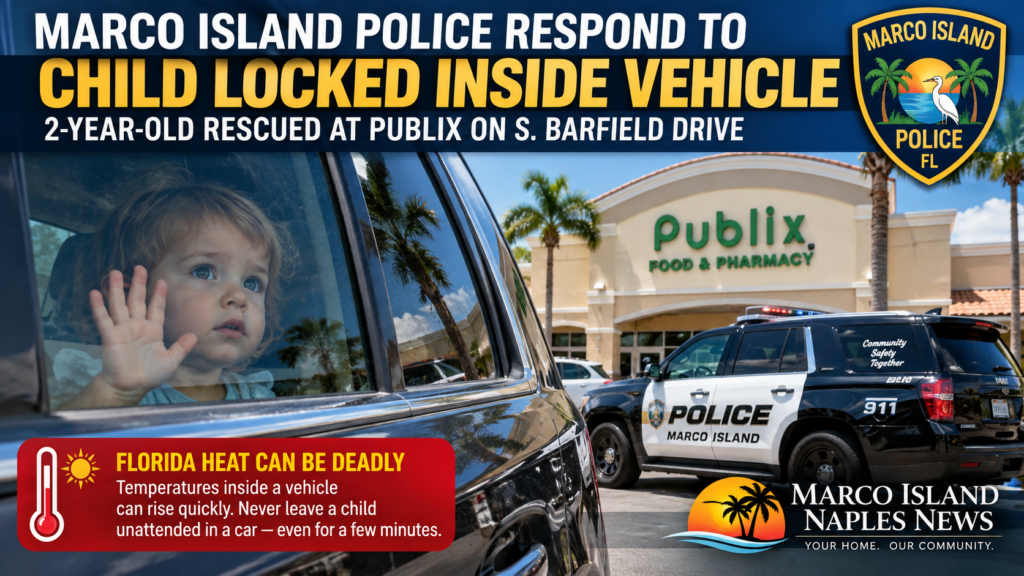
Marco Island Police Rescue 2-Year-Old Accidentally Locked Inside Vehicle at Publix
MARCO ISLAND, Fla. — A frightening situation at a Marco Island Publix ended safely after police officers rescued a 2-year-old child who had accidentally become locked inside a vehicle.
Earlier Saturday, Marco Island Police officers responded to the Publix on S. Barfield Drive following a report of a young child locked inside a vehicle.
According to police, the child’s parents had safely placed the 2-year-old inside the vehicle while they loaded groceries. As they continued loading the vehicle, it unexpectedly locked — leaving the child, vehicle keys and a phone inside.
The parents immediately sought help.
Police emphasized that the child was not intentionally left or abandoned inside the vehicle and that there was no wrongdoing by the parents.
🚔 Officer Breaks Window to Reach Child
Responding officers determined they needed to act quickly and broke one of the vehicle’s windows to gain access and remove the child.
Thankfully, the 2-year-old was okay following the ordeal.
One Marco Island Police officer suffered minor injuries during the rescue and was treated at the scene.
☀️ A Reminder About Florida’s Heat
The incident ended safely, but it also serves as an important reminder of how quickly the temperature inside a parked vehicle can rise — particularly during Southwest Florida’s hot and humid weather.
Even an accidental lockout can become dangerous quickly when a young child is trapped inside.
Marco Island Police encouraged residents and visitors to remain especially alert during periods of extreme heat.
Thankfully, quick action by the parents and responding officers turned what could have become a serious emergency into a safe outcome.
Marco Island Naples News will provide additional information if it becomes available.
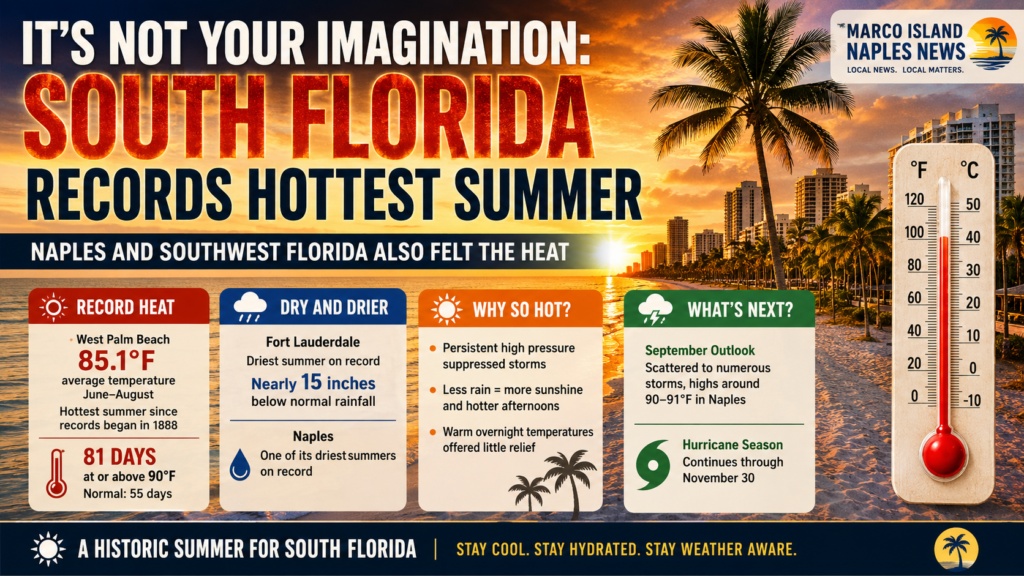
🔥 It’s Not Your Imagination: South Florida Just Endured a Record-Breaking Hot Summer
Naples and Southwest Florida also felt the heat as temperatures soared and rainfall struggled to keep pace
MARCO ISLAND, Fla. — September 3, 2026 — If it seemed like stepping outside this summer meant immediately walking into a sauna, the weather records suggest your imagination wasn’t the problem.
South Florida has officially wrapped up an exceptionally hot summer, with several cities recording or tying their hottest meteorological summer on record.
Meteorological summer covers June 1 through August 31, and preliminary climate numbers show just how unusual the past three months were.
West Palm Beach recorded an average summer temperature of 85.1°F (29.5°C) — the hottest summer there since weather records began in 1888. The previous record was 84.8°F, reached in 2011 and 2016.
Fort Lauderdale also experienced record summer heat, while Miami was among the locations reaching historic levels. Across southeast Florida, average temperatures from June through August climbed to the top of long-term climate rankings.
And Southwest Florida wasn’t exactly enjoying air-conditioning weather outdoors either.
🌡️ Naples Felt the Heat Too
While the most dramatic records were recorded along Florida’s southeast coast, Naples and Collier County experienced another punishing summer of heat and humidity.
The National Weather Service office in Miami — which covers Collier County — has characterized summer 2026 across South Florida as a period of record heat and much drier-than-normal conditions.
By late August, Naples was experiencing one of its driest summers on record, according to reporting based on regional climate data.
For Marco Island and Naples residents, the numbers reinforce what anyone spending time outdoors already knew: this was a very hot summer.
🔥 West Palm Beach Had 81 Days Above 90°F
One of the most remarkable statistics came from West Palm Beach.
Temperatures reached at least 90°F (32.2°C) on 81 days during meteorological summer.
Normally, West Palm Beach records about 55 days at or above 90°F during summer.
That means temperatures reached the 90-degree mark during roughly nine out of every ten days between June and August.
And because Florida humidity frequently pushes the heat index far above the actual air temperature, the conditions often felt considerably hotter.
🌧️ The Other Problem: Not Enough Rain
Extreme temperatures weren’t the only unusual feature of summer 2026.
Parts of South Florida also experienced significant rainfall shortages.
By August 21, Fort Lauderdale had received only about 5.94 inches of rain for the summer, leaving the city roughly 14 inches below normal at that point.
Miami was also more than 14 inches below average, while Naples was experiencing its fourth-driest summer to that point.
That’s particularly notable because summer normally represents the heart of South Florida’s wet season.
Afternoon thunderstorms are typically a near-daily feature of life from Marco Island to Miami, helping cool temperatures while replenishing canals, wetlands and groundwater.
When those thunderstorms become less frequent, temperatures can climb even higher because there are fewer clouds and rain-cooled afternoons.
☀️ Why Was It So Hot?
Several atmospheric factors can contribute to a Florida summer like this.
Persistent high pressure can suppress widespread thunderstorms, reduce cloud cover and allow more solar heating during the afternoon.
Less rainfall can then reinforce the heat.
Normally, a thunderstorm developing at 2 or 3 p.m. can quickly knock temperatures down by 10 degrees or more in parts of Southwest Florida.
Take those storms away and temperatures can remain near 90 degrees well into the afternoon.
Warm overnight temperatures are another important part of the equation.
When nighttime temperatures remain in the upper 70s or around 80 degrees, there is little opportunity for buildings, pavement and the human body to cool down before the next day’s heat arrives.
🌴 Marco Island’s Coastal Location Helps — A Little
Marco Island’s location directly along the Gulf of Mexico can provide some moderation compared with inland communities.
Sea breezes frequently prevent coastal temperatures from climbing quite as high as areas farther inland.
But there’s a tradeoff.
Warm Gulf waters also help keep humidity high and nighttime temperatures elevated.
That can produce the familiar Southwest Florida combination of a temperature around 90°F but a heat index approaching or exceeding 100°F.
In other words, the thermometer doesn’t need to show triple digits for conditions to feel like triple digits.
🌧️ September Could Bring More Rain
There is at least some potential relief as South Florida enters September.
The National Weather Service expects an active pattern during the opening days of the month, with scattered to numerous showers and thunderstorms developing each day.
High temperatures around South Florida are still expected to reach the lower 90s, however.
For Naples, the NWS forecast calls for temperatures around 90–91°F (32–33°C) with recurring chances for thunderstorms.
Those storms could finally provide some badly needed rainfall, although slow-moving thunderstorms can also produce localized flooding.
🌀 Hurricane Season Isn’t Finished
There’s another important reminder for Southwest Florida residents.
Meteorological summer may have ended August 31, but Atlantic hurricane season continues through November 30.
September historically falls within the most active portion of hurricane season, meaning residents should continue monitoring the Atlantic, Caribbean and Gulf of Mexico even as attention begins shifting toward fall.
Warm ocean temperatures also remain capable of supporting tropical development when atmospheric conditions become favorable.
🍂 When Does Southwest Florida Finally Cool Down?
That’s the question many Marco Island and Naples residents are probably asking.
Unfortunately, September rarely delivers an immediate taste of fall.
Average temperatures remain high through much of the month, and hot, humid conditions can continue well into October.
Southwest Florida’s more noticeable seasonal change generally arrives later in the fall as cold fronts begin reaching farther south.
Until then, the shorts, sunscreen and air conditioning aren’t going anywhere.
After one of South Florida’s hottest summers on record, however, even an 85-degree afternoon may eventually start feeling refreshing.
Sources: National Weather Service Miami–South Florida climate and forecast data; regional climate records; WPTV; WUSF; USA TODAY Network reporting; South Florida Sun Sentinel.
Marco Island Naples News | Weather & Climate

🏠 Florida Housing Market Hits the Brakes — But Southwest Florida Tells a More Complicated Story
MARCO ISLAND, Fla. — September 2, 2026 — Florida’s once-red-hot housing market has cooled dramatically, with price reductions, longer selling times and increasingly motivated sellers replacing the bidding wars that defined the pandemic-era real estate boom.
But here in Southwest Florida, the picture isn’t quite as simple as saying the housing market is in a “meltdown.”
New data show that Marco Island, Naples, Cape Coral and Fort Myers are moving in very different directions depending on location, property type and price range.
📉 Marco Island Sellers Are Negotiating
Marco Island provides one of the clearest examples of how dramatically conditions have changed for sellers.
According to Zillow data through July 31, the typical Marco Island home value was about $849,357, down approximately 0.9% from a year earlier.
More revealing is what happens when homes actually sell.
Approximately 91% of Marco Island sales closed below their listing price in June, while only about 3% sold above asking.
Homes were taking roughly 88 days to reach pending status.
Other housing data show an even sharper correction. Redfin reported that the median Marco Island sale price over the three months ending in July was approximately $892,000 — down 10.8% from the same period last year.
In other words, buyers appear to have regained something they haven’t enjoyed in several years:
Negotiating power.
🏡 Naples Isn’t Exactly Collapsing
Travel a few miles north, however, and the numbers tell a different story.
Florida Gulf Coast University’s Regional Economic Research Institute reported 434 existing single-family home sales in the Naples-Immokalee-Marco Island metro area during July, up nearly 10% from July 2025.
The median single-family sale price was approximately $800,000 — actually 11.1% higher than a year earlier.
That doesn’t look much like a housing meltdown.
It demonstrates why Florida’s housing market can’t be described accurately with one statewide headline.
Luxury homes, condos, investment properties and ordinary single-family homes can experience completely different market conditions — even within the same county.
🌴 Southwest Florida Inventory Is Shrinking
There’s another interesting development.
After years of rapidly increasing inventory, the number of properties available across parts of Southwest Florida has begun falling.
July data from the Coconut Coast Organization of REALTORS showed homes available for sale declined from a year earlier by roughly:
🏠 Naples: 22%
🌴 Fort Myers: 21%
🌊 Bonita Springs: 32%
☀️ Estero: 30%
Naples had roughly six months of housing supply, a level generally associated with a much more balanced market than the extreme seller’s market experienced during the pandemic.
💰 Florida Sellers Face a New Reality
Statewide, however, there is little question that sellers have lost much of the pricing power they enjoyed between 2020 and 2022.
HousingWire reported earlier this year that approximately 44% of Florida listings had experienced a price reduction.
High mortgage rates remain one of the biggest obstacles.
Rates hovering near the upper-6% range have dramatically increased monthly payments compared with the ultra-low mortgage rates available during the pandemic.
Florida buyers also face expenses that can be particularly painful here:
🏠 Rising homeowners insurance costs
🌊 Flood insurance
🏢 Condo association fees
💵 Property taxes
🔨 Maintenance and repair expenses
Those costs can turn an apparently affordable home into a significantly more expensive monthly commitment.
🏢 Condos Face Their Own Challenges
Florida’s condominium market has experienced additional pressure.
Following the Surfside condominium collapse, Florida adopted stricter structural inspection and reserve requirements for many older condominium buildings.
Those changes can result in higher association fees or substantial assessments for owners when buildings require repairs or additional reserves.
For buyers considering an older Southwest Florida condo, the monthly HOA payment and potential assessments have therefore become nearly as important as the purchase price itself.
🌴 Cape Coral and Fort Myers Have Corrected From Their Peak
Lee County has experienced a particularly noticeable reset.
The Cape Coral-Fort Myers metro area’s housing values remain substantially below their pandemic-era peak.
Data compiled from Redfin, Zillow and Realtor.com show the area’s housing market has shifted much closer to balanced conditions.
Yet recent numbers also show signs of stabilization.
Florida Gulf Coast University reported 1,331 existing single-family home sales in July, approximately 13% more than July 2025.
The median sale price was $385,000, up about 2.7% year over year.
That suggests the market may be moving beyond the rapid correction phase and toward something considerably more normal.
📊 The Pandemic Housing Boom Is Over
Perhaps that’s the biggest takeaway.
The extraordinary Florida housing market of 2020-2022 — characterized by bidding wars, cash offers, rapidly escalating prices and homes selling almost immediately — appears firmly in the rearview mirror.
Buyers can once again negotiate.
Sellers must price properties realistically.
Homes can sit on the market for months.
Price reductions are common.
And purchasing decisions increasingly depend on insurance, interest rates, HOA costs and affordability rather than fear of missing out.
🗳️ Housing Could Become a Political Issue
Florida’s affordability problems are also likely to attract increasing political attention heading toward the 2026 midterm elections.
Housing costs affect homeowners, renters, retirees and younger Floridians attempting to purchase their first homes.
But describing Florida’s entire housing market as collapsing would overlook an important reality.
Some markets are falling. Some are stabilizing. And some segments of Southwest Florida are actually seeing higher prices and stronger sales.
For Marco Island and Naples residents, the biggest change may simply be that the days when sellers could name almost any price and expect buyers to line up are gone.
Bottom Line
🏠 Marco Island: Prices remain under pressure and buyers have considerable negotiating power.
🌴 Naples: Single-family sales and median prices have recently strengthened.
📉 Cape Coral/Fort Myers: Prices remain below their pandemic-era highs, but sales are improving.
💰 Florida overall: High mortgage rates, insurance costs and affordability remain major obstacles.
⚖️ Market direction: Southwest Florida increasingly resembles a balanced market rather than either the pandemic-era housing frenzy or a full-scale housing crash.
The Florida housing boom is over. What comes next may look less like a meltdown — and more like a long-awaited return to reality.
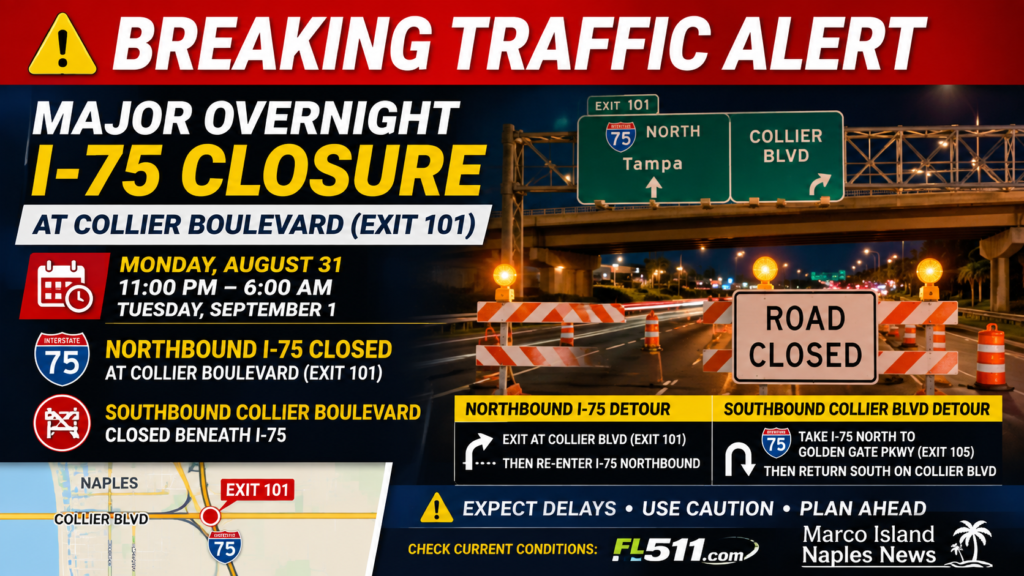
🚧 Major Overnight I-75 Closure Coming to Collier Boulevard Tonight
COLLIER COUNTY, Fla. — Drivers traveling through eastern Naples and Collier County tonight should prepare for a significant overnight closure at one of the area’s busiest Interstate 75 interchanges.
Northbound I-75 at Collier Boulevard (Exit 101) is scheduled to completely close overnight Monday, August 31, into Tuesday morning, September 1, as construction crews perform bridge work.
The closure is expected to begin at approximately 11 p.m. Monday and continue until 6 a.m. Tuesday.
🚧 What Will Be Closed?
During the construction operation:
Northbound I-75 will be closed at Collier Boulevard/Exit 101.
Southbound Collier Boulevard beneath I-75 will also be closed.
Motorists should expect detours, slower traffic and possible delays around the interchange.
Law enforcement is expected to assist with traffic control.
The overnight closure is necessary while crews conduct a bridge deck concrete pour associated with ongoing improvements in the I-75 corridor.
🚗 Northbound I-75 Detour
Drivers heading north on I-75 from Alligator Alley and Marco Island-area connections will be required to exit the interstate at Collier Boulevard (Exit 101).
Traffic will then be directed through the interchange before motorists can re-enter I-75 northbound.
Although the work is scheduled during lower-volume overnight hours, backups could develop approaching Exit 101, particularly when the closure first begins.
↩️ Collier Boulevard Detour
The closure will also affect motorists traveling southbound on Collier Boulevard beneath I-75.
Those drivers are expected to encounter a longer detour involving I-75 northbound to Golden Gate Parkway (Exit 105)before returning south.
Drivers unfamiliar with the interchange should allow additional travel time and watch closely for temporary construction signs and law-enforcement directions.
⚠️ Expect Construction Crews and Changing Traffic Patterns
Motorists approaching the I-75 and Collier Boulevard interchange overnight should reduce their speed and be prepared for traffic to move differently than usual.
Construction schedules can also change because of weather, equipment problems or other unforeseen circumstances.
Anyone traveling through the area should check current road conditions before leaving, particularly those heading to or from Naples, Marco Island, Golden Gate, Alligator Alley or other areas of eastern Collier County.
🚦 Bottom Line
Closure: Northbound I-75 at Collier Boulevard (Exit 101)
Additional closure: Southbound Collier Boulevard beneath I-75
Starts: 11 p.m. Monday, August 31
Scheduled reopening: 6 a.m. Tuesday, September 1
Reason: Bridge deck construction
Expect: Detours and possible overnight delays
Marco Island Naples News will continue monitoring major crashes, road closures and traffic disruptions across Collier County.

🐻 Young Black Bear Breaks Into Naples Zoo, Visitors Evacuated
NAPLES, Fla. — August 29, 2026 — Visitors at Naples Zoo at Caribbean Gardens got an unexpected wildlife encounter Saturday after a young wild black bear reportedly entered the zoo grounds, prompting an evacuation of guests.
WINK News reported the incident Saturday afternoon, saying visitors were evacuated after the bear made its way onto the property. The report was published at approximately 5:33 p.m. Saturday.
The unusual situation is especially noteworthy because Naples Zoo already houses American black bears as part of its animal collection. The zoo’s daily schedule currently includes a 2 p.m. black bear presentation, and the Florida Fish and Wildlife Conservation Commission lists Naples Zoo among Florida facilities where visitors can see American black bears.
🐾 Wild Bears Are Found in Southwest Florida
Although seeing a wild bear inside a zoo may sound bizarre, Florida black bears can turn up throughout the state. FWC says bears have been documented in nearly every part of Florida and may travel considerable distances while searching for food, water and suitable habitat.
Naples Zoo is located along Goodlette-Frank Road in central Naples on a heavily landscaped property surrounded by developed areas, making Saturday’s surprise visitor an unusual encounter in the middle of the city.
🚨 Visitors Evacuated as Precaution
The evacuation appears to have been undertaken as a safety precaution while authorities and zoo personnel dealt with the wild bear.
As of Saturday evening, publicly available reports had not yet provided full details on exactly how the bear entered the property, how long it remained inside the zoo or how it was ultimately removed.
There were also no immediately confirmed reports of injuries connected with the incident.
This remains a developing story, and additional details are expected as Naples Zoo, wildlife officials or local authorities release more information.
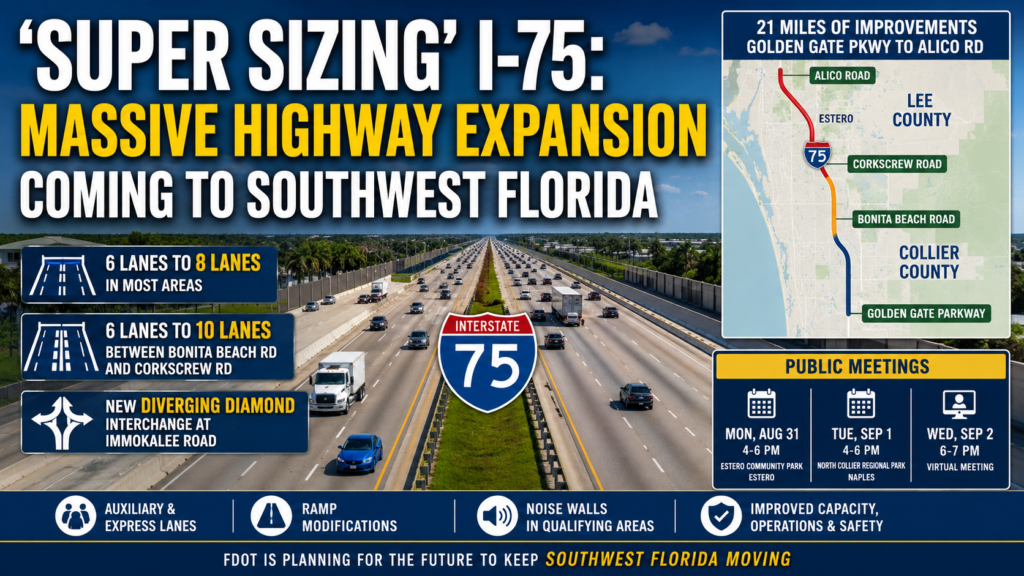
🚧 ‘Super Sizing’ I-75: Massive Highway Expansion Coming to Southwest Florida
MARCO ISLAND NAPLES NEWS — Saturday, August 29, 2026
If you already think Interstate 75 through Southwest Florida feels enormous, get ready — I-75 is about to get a whole lot bigger.
The Florida Department of Transportation is moving forward with one of the most significant highway expansions Southwest Florida has seen, with improvements planned along roughly 21 miles of I-75 between Golden Gate Parkway in Collier County and Alico Road in Lee County.
And along part of the route, six lanes could become 10. (aol.com)
🛣️ From Six Lanes to Eight — and Even 10
The biggest change is expected along the heavily traveled stretch between Bonita Beach Road and Corkscrew Road, where current plans call for I-75 to expand from six lanes to 10 lanes.
Other portions of the corridor would generally grow from six lanes to eight, while FDOT is also proposing auxiliary and express lanes in portions of the project. (aol.com)
In other words, this isn’t simply another resurfacing job.
This is a fundamental expansion of Southwest Florida’s primary north-south interstate.
FDOT says the purpose is straightforward: increase highway capacity, improve traffic operations and enhance safetyas Lee and Collier counties continue to grow. Without additional capacity, the agency warns congestion along the corridor will continue to worsen. (flrules.org)
🔀 Immokalee Road Is Getting a Major Makeover
One of the most noticeable changes for Collier County drivers would come at I-75 and Immokalee Road.
FDOT proposes rebuilding the interchange as a diverging diamond interchange, commonly called a DDI.
A diverging diamond temporarily moves traffic to the opposite side of the roadway as it passes through the interchange. While that can look confusing the first time you encounter one, the design allows vehicles turning onto interstate ramps to avoid crossing opposing traffic.
The project also includes ramp modifications at key interchanges, resurfacing and construction of noise walls at locations that meet FDOT’s qualifying criteria. (flrules.org)
💰 This Has Been Years in the Making
The expansion is part of Florida’s Moving Florida Forward Infrastructure Initiative, designed to accelerate major transportation projects in rapidly growing areas.
Earlier plans for the Golden Gate Parkway-to-Corkscrew Road portion called for widening approximately 18.5 miles of I-75 from six to eight lanes, including auxiliary lanes. FDOT previously placed funding for that portion at approximately $578 million. (fdot.gov)
The scope now being presented extends farther north to Alico Road and includes additional improvements.
FDOT’s current work-program records classify the Golden Gate-to-Corkscrew portion as an “Add Lanes & Reconstruct” project, with design-build procurement activity underway.
🚗 Why I-75 Needs More Room
Anyone who regularly drives between Naples, Bonita Springs, Estero and Fort Myers probably doesn’t need a traffic study to know what’s happening.
Southwest Florida continues to grow.
More homes mean more commuters. More visitors mean more rental cars. More businesses mean more trucks and employees using the interstate.
Then throw in crashes, construction and seasonal traffic and I-75 can quickly turn into a parking lot.
FDOT says the expansion is intended to accommodate future travel demand while improving safety and traffic flow. The additional capacity could also prove important during hurricane evacuations, when I-75 becomes one of Southwest Florida’s critical escape routes.
🚧 The Catch: We Have to Build It First
Of course, adding as many as four lanes to an operating interstate isn’t exactly a weekend project.
The work is expected to be completed in phases over several years. (aol.com)
That means Southwest Florida motorists should eventually expect construction zones, shifting lanes, nighttime closures, reduced shoulders and ramp changes as the massive project moves forward.
The long-term goal is less congestion.
Getting there may require some patience.
A lot of patience.
🗣️ FDOT Wants to Hear From Southwest Florida
Before the major work gets underway, residents have an opportunity to see exactly what FDOT is proposing.
📍 Lee County Open House
Monday, August 31, 2026
🕓 4 p.m. – 6 p.m.
📍 Estero Community Park
9200 Corkscrew Palms Boulevard
Estero
📍 Collier County Open House
Tuesday, September 1, 2026
🕓 4 p.m. – 6 p.m.
📍 North Collier Regional Park
Exhibit Hall Room A
15000 Livingston Road
Naples
💻 Virtual Meeting
Wednesday, September 2, 2026
🕕 6 p.m. – 7 p.m.
All three meetings will present the same project information. Residents attending in person will be able to examine proposed improvements — including potential noise-wall locations — and speak directly with members of the project team. Virtual participants will be able to view the plans and submit questions. (flrules.org)
🌴 What It Means for Naples, Marco Island and Collier County
For Marco Island residents, I-75 may not run across the island, but it remains a critical transportation artery for reaching Fort Myers, Southwest Florida International Airport and destinations throughout the state.
The project also comes as Collier County deals with continued development east of Naples and growing pressure on major corridors including Collier Boulevard, Immokalee Road and Golden Gate Parkway.
An eight- and, in places, 10-lane I-75 would dramatically change the interstate we’ve known for decades.
Whether it will finally stay ahead of Southwest Florida’s seemingly endless population growth is another question.
For now, one thing is certain:
🚧 The Southwest Florida version of I-75 is about to get supersized.
I’d use “‘Super Sizing’ I-75: Massive Highway Expansion Coming to Southwest Florida” as the main headline — it has a strong local-news/Google Discover feel while still accurately describing the project. (flrules.org)

🐻 What Could Be More Fun Than Killing a Defenseless Bear? Florida Bear Hunt Applications Opening Soon
FLORIDA — Just when you thought December was already overflowing with festive activities — decorating trees 🎄, exchanging gifts 🎁, spending time with family ❤️ and pretending to enjoy your neighbor’s fruitcake — Florida has another seasonal tradition available this year:
🐻 Going into the woods and shooting a bear.
Because apparently nothing says “the holidays are here” quite like camouflage, a rifle and explaining to your relatives why there’s suddenly a 300-pound conversation piece headed for the taxidermist.
Florida’s 2026 bear hunt is scheduled for December 5–27, with permit applications opening September 11 and running through September 21.
💳 First, You Must Pay for the Privilege of Applying
Naturally, this sophisticated outdoor experience begins with a financial transaction.
Applications cost $5 each.
If selected, permits cost:
🏠 Florida residents: $100
✈️ Non-Florida residents: $300
Yes, visitors pay triple.
Apparently Florida bears are like theme parks: residents get a discount.
🐻 The Apex Predator Meets the Apex Consumer
There is something undeniably grand about humanity’s long march through technological progress.
We developed agriculture. 🌾
We built cities. 🏙️
We split the atom. ⚛️
We landed on the Moon. 🌕
And after thousands of years of civilization, some of us still apparently wake up and think:
“You know what would really complete my living room? A bear.”
Nothing demonstrates mankind’s mastery of nature quite like arriving with modern firearms, GPS, trucks, coolers and enough outdoor equipment to outfit a small infantry unit — then triumphantly posing beside an animal that had absolutely no idea it had entered a sporting competition.
🎩 A Distinguished Pursuit for the Refined Outdoorsman
Of course, supporters of regulated bear hunting argue that hunting can be used as a wildlife-management tool, particularly where bear populations and human development increasingly overlap.
And wildlife management is a legitimate subject worthy of serious debate.
But satire has a question:
Do we have to look quite so delighted in the photographs?
There’s always that pose.
One boot strategically positioned nearby.
Rifle prominently displayed.
Sunglasses on.
A facial expression suggesting the hunter has personally defeated nature in single combat.
Sir, you did not wrestle the bear.
You had a scope.
🏡 Meanwhile, Florida Keeps Building
Perhaps the most exquisitely Floridian part of the entire discussion is our complicated relationship with wildlife habitat.
We build another subdivision. 🏘️
Then another shopping center. 🛒
Then another six-lane road. 🚙
Then another gated community called something like “Bear Preserve at Whispering Pines.”
Eventually an actual bear wanders through Bear Preserve at Whispering Pines and everyone reacts:
🚨 WHY IS THERE A BEAR HERE?!
The bear, presumably, is equally confused.
“Funny, there used to be a forest here.”
🎄 Coming This December: A Very Florida Christmas
So mark your calendars.
📅 Applications: September 11–21
🐻 2026 bear hunt: December 5–27
💵 Application: $5
🌴 Resident permit: $100
🧳 Non-resident permit: $300
Whether you consider the hunt responsible wildlife management, an established hunting tradition or an activity approximately as sporting as challenging your Roomba to a duel, one thing is certain:
Florida has once again found a way to make December interesting.
While some families will be hanging stockings by the fireplace, others may apparently be deciding what should hang overthe fireplace.
🐻🎄
Because nothing captures the peaceful spirit of the holiday season quite like looking at a magnificent wild animal and thinking:
“That would look fantastic next to the television.”
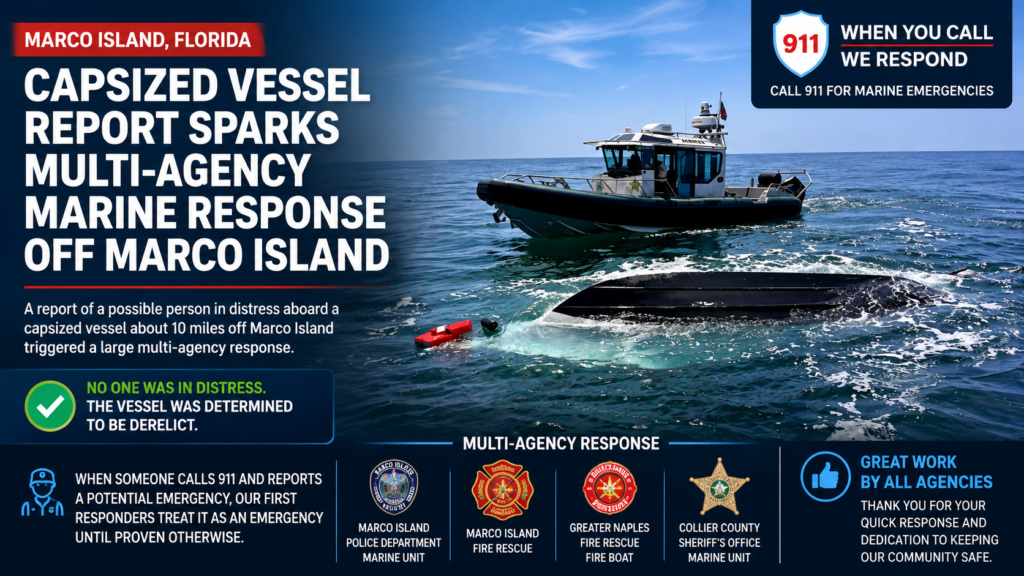
Capsized Vessel Report Sparks Multi-Agency Marine Response Off Marco Island
MARCO ISLAND, Fla. — A report of a possible person in distress aboard a capsized vessel about 10 miles off Marco Island triggered a large multi-agency marine emergency response Wednesday.
The incident began when an aircraft returning to Naples Airport spotted an overturned vessel offshore. Believing there could potentially be a person on or near the vessel, the aircraft crew contacted 911.
Because the report involved a possible marine emergency, the Collier County Marine Emergency Response Team (MERT) was activated. MERT coordinates law enforcement and fire-rescue marine resources based on geographic response zones.
The Marco Island Police Department Marine Unit, which was already on the water, immediately headed toward the reported location.
Crews from the Marco Island Fire Rescue boat, Greater Naples Fire Rescue fire boat and Collier County Sheriff’s Office marine units also responded.
When first responders reached the vessel, they determined it was derelict and that no emergency had occurred. No one was found in distress and no rescue was necessary.
The outcome was welcome news after crews responded under the possibility that someone’s life could be in danger.
“When someone calls 911 and reports a potential emergency, our first responders treat it as an emergency until proven otherwise.”
The incident also demonstrates how quickly multiple agencies can mobilize when an emergency is reported in the waters surrounding Marco Island and Collier County.
Thankfully, this time the capsized vessel turned out to be abandoned rather than the scene of an active emergency.
Bottom line: It was a false alarm — but exactly the kind of false alarm everyone hopes for when first responders are racing toward a possible emergency offshore.
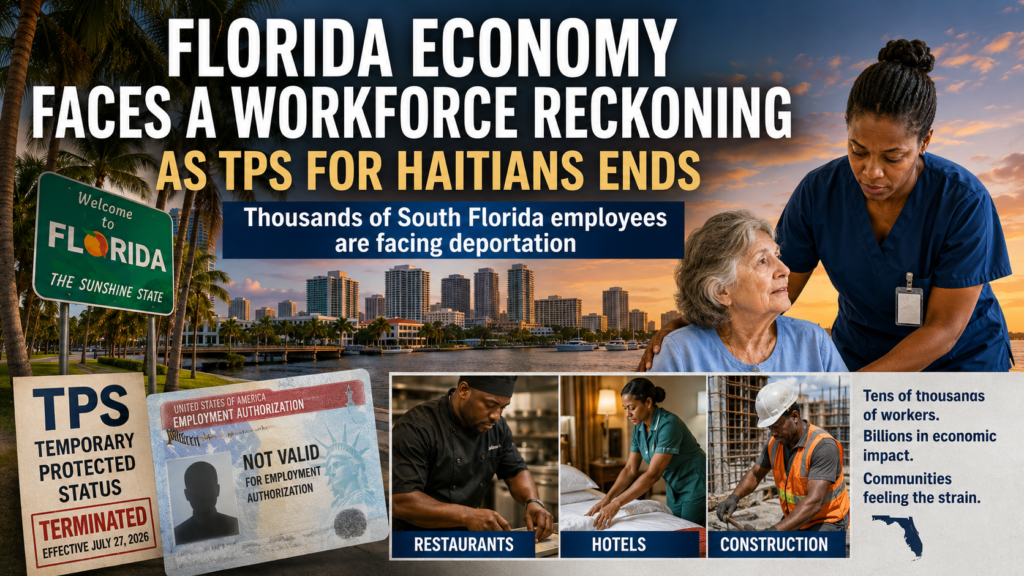
Florida Economy Faces a Workforce Reckoning as TPS for Haitians Ends
Thousands of workers lose employment authorization as health care, hospitality and other industries confront new staffing shortages
FLORIDA — August 27, 2026 — Florida businesses are beginning to feel the economic consequences of the end of Temporary Protected Status for Haitians, with tens of thousands of workers potentially disappearing from a labor force already struggling to fill jobs in health care, hospitality, restaurants and other service industries.
The federal government terminated Haiti’s Temporary Protected Status, or TPS, effective July 27, 2026. Federal guidance says employment authorization documents issued on the basis of Haitian TPS are no longer valid, meaning employers must reverify affected employees and cannot continue employing workers who cannot demonstrate another legal authorization to work. (content.govdelivery.com)
The impact could be particularly severe in Florida.
An analysis by FWD.us, the Haitian Bridge Alliance and UndocuBlack Network estimated that approximately 93,000 Haitian TPS holders were working in Florida before the termination. The analysis estimated those workers contributed about $2.6 billion annually to Florida’s economy, along with roughly $306 million in state and local taxes and $300 million in federal and payroll taxes. (fwd.us)
Among those Florida workers were an estimated:
16,000 cooks and restaurant servers
12,000 agricultural workers
8,000 stockers and packers
5,000 security guards
4,000 nursing assistants (axios.com)
Those numbers help explain why the loss of Haitian workers is becoming more than an immigration issue.
It is rapidly becoming a Florida workforce issue.
🏥 Health Care and Senior Care Among the Hardest Hit
One of the most vulnerable industries is health care, particularly home health and senior care.
Haitian immigrants have become an important part of Florida’s direct-care workforce. Haitians account for an estimated 28% of Florida’s immigrant direct-care workers, according to PHI data cited by the Home Care Association of Florida. (members.homecarefla.org)
Recent reports indicate some South Florida home-care agencies have already closed after losing large numbers of TPS workers, while nursing homes and other providers are scrambling to replace employees. (members.homecarefla.org)
For an industry that was already struggling to recruit caregivers, losing thousands of experienced employees could translate into higher overtime costs, fewer available caregivers and potentially longer waits for families trying to arrange care.
🌴 Naples Is Already Seeing the Impact
The workforce disruption isn’t limited to Miami-Dade and Broward counties.
It has reached Southwest Florida.
Moorings Park Communities, the senior-living organization in Naples, recently lost seven employees whose TPS-based work authorization expired, according to reporting on the Florida labor shortage. Another 17 workers had previously left amid uncertainty surrounding the program’s termination. (members.homecarefla.org)
Administrators have so far adjusted staffing, and one affected employee was able to return after obtaining another form of employment authorization.
But the impact isn’t measured only in vacant positions.
Senior-care employees often develop long-term relationships with residents, meaning losing experienced caregivers can affect continuity of care as well as staffing.
Moorings Park CEO Daniel Lavender described the loss for residents who had formed relationships with those caregivers as “a personal, devastating loss.” (members.homecarefla.org)
For Naples and Collier County, that example is particularly significant.
Southwest Florida has a large retiree population and a substantial senior-living and health-care industry. Any sustained shortage of caregivers could put additional pressure on facilities already competing for workers.
🍽️ Restaurants, Hotels and Tourism Face Another Challenge
Florida’s tourism economy could also feel the effects.
Haitian TPS workers have been employed throughout hotels, restaurants, resorts, retail operations, airports and other service businesses.
In Key West, one restaurant suspended six longtime Haitian employees after they lost authorization to work, according to the Associated Press. Some had worked there for more than a decade as cooks, busboys and oyster shuckers. (apnews.com)
Elsewhere, restaurants have reportedly reduced operating hours while hotels, retailers, airport contractors and small businesses contend with staffing shortages. (wsj.com)
That could become especially relevant for tourism-heavy communities such as Naples and Marco Island, where restaurants, resorts, hotels, landscaping companies, construction businesses and service industries depend on a large year-round workforce.
The real test may arrive as Southwest Florida moves toward its busy winter tourism season.
💰 Billions in Economic Activity at Stake
The debate also extends beyond the number of jobs.
The January 2026 analysis of Haitian TPS workers estimated their annual contribution to Florida’s economy at approximately $2.6 billion. (fwd.us)
Workers who leave Florida—or are forced out of employment—don’t just disappear from payrolls.
Their spending can disappear as well.
Rent, groceries, transportation, restaurants, clothing and other household purchases all circulate through local economies.
Employers attempting to replace departing workers may meanwhile face higher recruitment expenses, training costs and overtime.
For businesses operating on thin margins, particularly restaurants and home-care agencies, those expenses can quickly become significant.
🇺🇸 Supporters of Ending TPS Say the Program Was Never Meant to Be Permanent
There is another side to the debate.
The Trump administration has argued that Temporary Protected Status was designed to provide temporary, rather than permanent, protection to people whose home countries were experiencing extraordinary conditions.
Haitians initially received TPS following Haiti’s catastrophic 2010 earthquake, and the protection was repeatedly extended.
The administration contends those repeated extensions transformed a temporary immigration program into something approaching permanent residency without congressional authorization.
Federal guidance says the determination was made after reviewing conditions in Haiti and consulting appropriate government agencies, concluding that Haiti no longer met the statutory requirements for TPS designation. (content.govdelivery.com)
Supporters of ending TPS also argue that removing foreign workers from the labor market could create additional opportunities for American workers and potentially force employers to increase wages.
Steven Camarota of the Center for Immigration Studies, which advocates for lower immigration levels, told the Wall Street Journal that the departures could create opportunities for less-educated American-born workers. (wsj.com)
Whether enough workers are available—or willing—to fill those positions remains one of the biggest unanswered economic questions.
🇭🇹 Deportation Fears Grow
For affected Haitian families, losing a job may be only the beginning.
Former TPS beneficiaries who don’t possess another lawful immigration status or form of relief can potentially face immigration enforcement and deportation. (cbsnews.com)
That prospect has generated considerable concern because Haiti continues to struggle with gang violence, political instability and humanitarian problems.
Miami-Dade officials and business leaders warned before the expiration that ending TPS could have substantial consequences for families and the regional economy. County officials estimated the change would affect hundreds of thousands of Haitian nationals nationally, including tens of thousands in Miami-Dade. (miamidade.gov)
📉 Florida Is Becoming the Economic Test Case
No state has more at stake than Florida.
The state has the country’s largest population of Haitian TPS holders, and South Florida contains one of the largest Haitian communities outside Haiti.
That means Florida is effectively becoming a real-world test of what happens when tens of thousands of legally employed workers suddenly lose their authorization to work.
Will wages rise enough to attract replacement workers?
Will businesses automate jobs or reduce services?
Will restaurants shorten their hours?
Will nursing homes and assisted-living facilities struggle to maintain staffing?
And will the economic consequences spread beyond South Florida into communities such as Naples and Marco Island?
Those questions won’t be answered overnight.
But less than two months before Southwest Florida’s seasonal economy begins accelerating toward winter, employers may not have much time to find out.
🌴 Southwest Florida Bottom Line
For Naples, Marco Island and Collier County, the end of Haitian TPS may initially appear to be an immigration story centered hundreds of miles away in Miami.
The experience at Moorings Park suggests otherwise.
If Florida loses a substantial portion of the estimated 93,000 Haitian TPS workers, the effects could eventually reach nearly every corner of the state’s service economy—from the caregiver assisting a senior citizen to the cook preparing dinner at a restaurant.
Florida’s immigration debate has now collided directly with its labor market.
And as businesses begin searching for replacement workers, the economic consequences of that collision are only beginning to emerge.

🚨 DOUBLE THE SCHOOL-ZONE SPEED LIMIT? TWO DRIVERS LEARNED AN EXPENSIVE LESSON ON MARCO ISLAND
Marco Island Police say two drivers were stopped within just 20 minutes of each other after allegedly traveling at least twice the posted speed limit in an active school zone.
🚨 Driver #1: 40 MPH in a 20 MPH zone
🚨 Driver #2: 44 MPH in a 20 MPH zone
Officer Prigge made both traffic stops, and each driver received a $453 citation.
When a Marco Island school zone is active, the speed limit is 20 MPH — and police are making it clear that speeding through one will not be tolerated.
The Marco Island Police Department says its priority is making sure children can safely travel to and from school.
Bottom line: Slow down. A few seconds saved behind the wheel isn’t worth risking a child’s life — or a $453 ticket.
📍 Marco Island, Florida
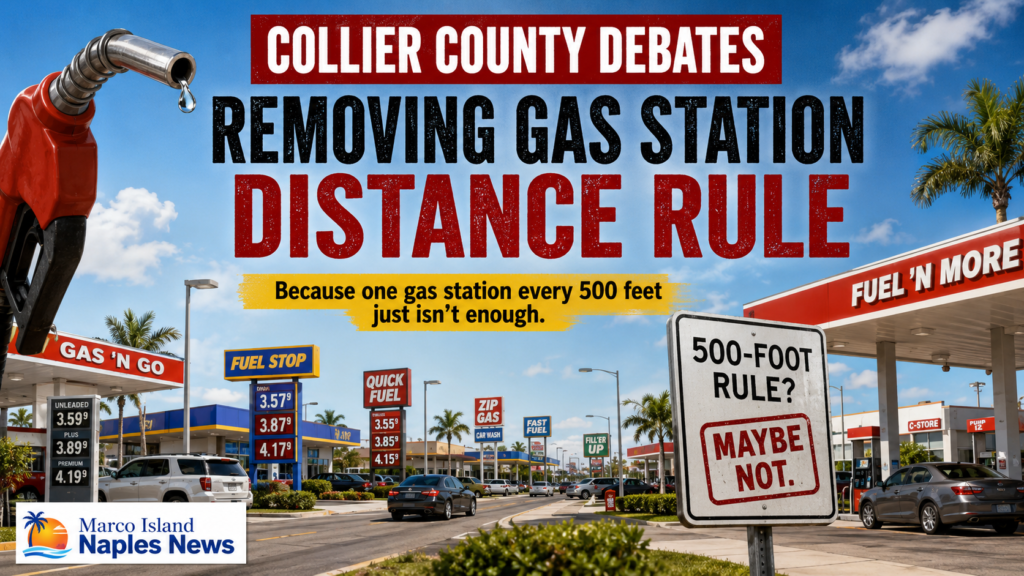
⛽ Collier County Considers Letting Gas Stations Get Even Closer — Because Apparently We’re Running Out of Them
The county’s 500-foot separation rule could disappear, potentially clearing the way for gas stations to become much friendlier neighbors.
COLLIER COUNTY, Fla. — Good news, Collier County motorists.
If you’ve ever been driving down the road, glanced nervously at your fuel gauge and thought, “My God, where am I going to find a gas station?” — help may finally be on the way.
Collier County commissioners are considering removing a rule requiring gas stations to be at least 500 feet apart.
Yes.
Five. Hundred. Feet.
Apparently, that vast gasoline desert may simply be too much for modern civilization to endure.
⛽ The Great 500-Foot Gas Station Wilderness
Under the current rules, properties with fuel pumps generally have to remain at least 500 feet away from another property with fuel pumps.
That’s roughly the length of a very long walk.
Possibly even two minutes.
For years, Collier County residents have somehow survived this brutal journey between convenience stores, navigating a dangerous landscape filled with Publix stores, Walgreens, CVS locations, banks, car washes, storage facilities and approximately 14,000 landscaping trucks.
But relief may be coming.
County officials are considering eliminating the separation requirement altogether.
🏪 Imagine the Possibilities
If the rule eventually disappears, gas stations could theoretically locate closer together, assuming they meet all the county’s other zoning and development requirements.
Which means one day you could potentially stand at a Collier County intersection and enjoy the magnificent sight of:
Gas station.
Gas station.
Car wash.
Bank.
Another gas station.
Storage facility.
Publix.
And, naturally, another car wash.
The complete Southwest Florida ecosystem.
Scientists may someday study it.
🚗 Competition Could Be Good for Drivers
There is, of course, a serious argument behind the proposal.
Allowing gas stations to locate closer together could increase competition and give motorists more choices.
And considering what filling up a vehicle costs these days, nobody is going to complain if two stations start fighting over customers by knocking a few cents off a gallon.
In fact, we’d happily support placing them six inches apart if it somehow gets regular unleaded back to a price that doesn’t require financing.
🛒 Costco Enters the Chat
The 500-foot rule attracted additional attention following controversy surrounding a proposed Costco gas station, where a waiver request generated public opposition.
And nothing brings a community together quite like three things:
Traffic.
Development.
And Costco.
Mention all three in the same Collier County meeting and somebody is immediately reaching for the microphone.
🚦 But What About Traffic?
Opponents may have a slightly different concern.
Gas stations aren’t exactly botanical gardens.
They generate traffic.
Cars enter.
Cars leave.
Delivery trucks arrive.
People suddenly realize the entrance was 40 feet behind them and attempt a maneuver normally seen only during NASCAR qualifying.
Putting several stations close together could potentially create additional congestion around already-busy intersections.
And if there’s one thing Collier County desperately needs, it’s apparently more vehicles attempting left turns across six lanes of traffic.
🏛️ Don’t Panic — Nothing Has Changed Yet
Before anyone begins camping outside the Government Center with a “SAVE THE 500 FEET” sign, commissioners aren’t immediately eliminating the rule.
The county is considering moving the proposal forward to a public hearing, where residents will have an opportunity to express their opinions.
And this being Collier County, we’re reasonably confident there will be opinions.
Many opinions.
Possibly several hours of opinions.
🌴 The Southwest Florida Development Starter Pack
The larger debate is really about what Collier County should look like as it continues growing.
More competition?
Fewer development restrictions?
More convenience?
Or another commercial corridor where you can buy gasoline, wash your car, store your belongings, pick up a prescription and open a checking account without traveling more than 600 feet?
These are the difficult questions facing modern government.
For now, the 500-foot gas station separation rule remains in place.
So until further notice, Collier County drivers may occasionally be forced to endure the terrifying experience of traveling approximately one-tenth of a mile before encountering another fuel pump.
Stay strong, everyone.
We will get through this.
Marco Island Naples News — Sometimes Funny, Sometimes Serious, Always Honest.
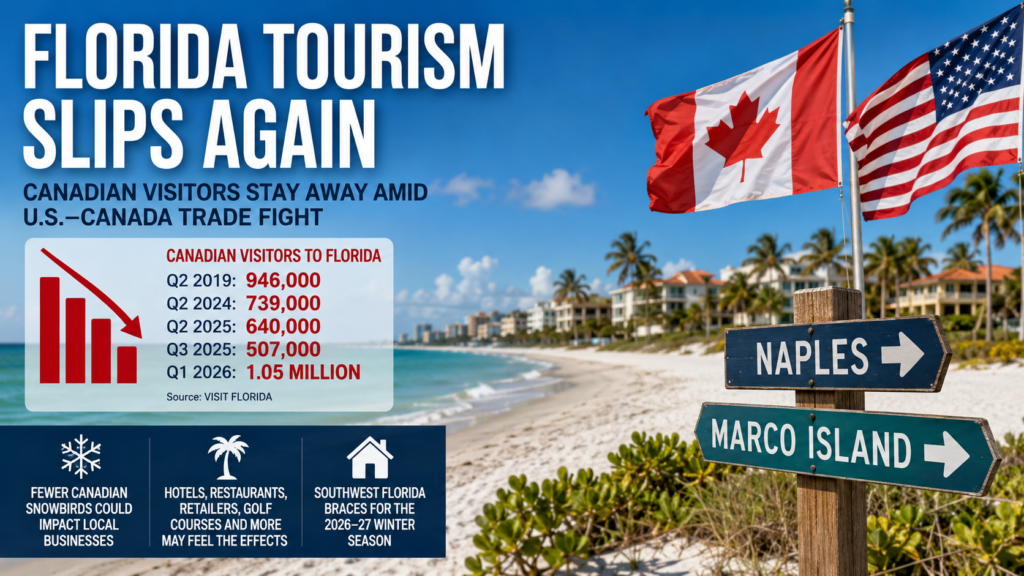
🇨🇦 Florida Tourism Slips Again as Canadian Visitors Stay Away Amid U.S.–Canada Trade Fight
MARCO ISLAND NAPLES NEWS — August 24, 2026
Florida’s tourism industry is beginning to feel the effects of a prolonged pullback by Canadian travelers, an important group for the Sunshine State — and particularly for winter destinations across Southwest Florida.
The latest tourism figures come as relations between the United States and Canada have deteriorated over tariffs and trade policy, adding another layer of uncertainty as Florida businesses prepare for the upcoming snowbird season.
Canadian travel to the United States has already fallen sharply. A Canadian government analysis found trips to the U.S. dropped 25% in 2025, representing roughly 7.1 million fewer trips. Canadians also spent about C$3.3 billion less on U.S. travel than they did a year earlier. (Axios)
📉 Florida Was Already Seeing the Warning Signs
Florida entered 2026 with Canadian tourism considerably weaker than its historical levels.
In the second quarter of 2025, Florida welcomed approximately 640,000 Canadian visitors, according to VISIT FLORIDA. Canadians represented just 1.9% of the state’s total visitors during the quarter. (Visit Florida)
For comparison, Florida received approximately 739,000 Canadians during the same quarter in 2024. (Visit Florida)
Go back to 2019, before the pandemic, and Florida welcomed roughly 946,000 Canadians during the second quarter alone. (Visit Florida)
The decline continued later in 2025. VISIT FLORIDA estimated 507,000 Canadian visitors during the third quarter, down from 597,000 a year earlier. (Visit Florida)
There was some improvement entering 2026. VISIT FLORIDA estimated 1.05 million Canadian visitors during the first quarter of 2026, representing about 2.6% of Florida’s total visitation. (Visit Florida)
But the broader trend remains a concern.
🇨🇦 Why Are Canadians Staying Away?
The tourism decline has increasingly become intertwined with deteriorating U.S.–Canada relations.
Tariffs, retaliatory trade measures and political tensions have contributed to a broader Canadian pullback from travel to the United States.
Those tensions intensified again this month.
On August 21, the United States imposed 50% tariffs on approximately $20 billion in Canadian goods after negotiations between the two countries failed to produce an agreement. Canada subsequently announced retaliatory tariffs on U.S. products. (Reuters)
Tourism isn’t formally part of the tariff system, of course.
But travelers can vote with their passports — and many Canadians appear to be doing exactly that.
Canadian travelers have increasingly shifted vacations toward destinations within Canada and overseas rather than the United States. Statistics cited in a recent Canadian government analysis showed that the millions of lost U.S. trips were largely replaced by additional domestic and overseas travel. (Axios)
🌴 Why This Matters to Marco Island and Naples
For Southwest Florida, Canadian tourism isn’t simply about people booking hotel rooms for a weekend.
Canadians have traditionally been a major part of Florida’s winter population, with seasonal residents and long-term visitors renting condos, owning second homes, eating at restaurants, golfing, boating, shopping and spending months at a time in the state.
That makes places such as Marco Island, Naples and greater Collier County particularly exposed to changes in Canadian travel behavior.
A Canadian family that normally spends several winter months in Southwest Florida represents far more economic activity than a typical short vacation.
The effects can ripple through:
🏨 Hotels and vacation rentals
🍽️ Restaurants and bars
🛍️ Retail businesses
🏠 Condos and seasonal rentals
⛳ Golf courses
🚤 Marinas and boating businesses
🚗 Rental-car companies
🏡 Second-home real estate
The real test for Southwest Florida could therefore arrive between November and March, when Canadian snowbirds traditionally head south.
🇺🇸 Domestic Travelers Are Still Florida’s Safety Net
There is an important counterpoint: Florida tourism is far from collapsing.
Domestic Americans continue to dominate Florida tourism.
During the first quarter of 2026, Florida welcomed an estimated 39.88 million visitors, with approximately 36.5 million coming from elsewhere in the United States. Domestic travelers represented 91.6% of all visitors. (Visit Florida)
Overseas tourism excluding Canada has also shown strength.
Florida recorded approximately 2.3 million overseas visitors during Q1 2026, an increase of 8.5% from the previous year. British visitation jumped 17.2%, while Irish visitation increased 14.5%. (Visit Florida)
That helps cushion Florida from the Canadian decline.
But replacing a traditional Canadian snowbird who spends weeks or months in Florida isn’t necessarily as simple as adding another short-term tourist.
❄️ The 2026–27 Snowbird Season Becomes the Big Test
For Marco Island and Naples, the most important question may not be how many Canadians visited Florida this summer.
It’s how many come back this winter.
If U.S.–Canada relations remain strained into late 2026, Southwest Florida businesses could face another season with fewer Canadian customers.
If political and trade tensions cool, Florida could see some of those travelers return.
Either way, Canadian tourism has become an economic indicator worth watching closely in Southwest Florida.
For decades, the annual migration from Ontario, Quebec and other Canadian provinces to Florida has been almost as predictable as afternoon thunderstorms in August.
This winter, that migration may be a little less predictable.
Marco Island Naples News will continue monitoring tourism numbers and what the Canadian travel slowdown could mean for Southwest Florida’s 2026–27 winter season.
Sources: VISIT FLORIDA Research
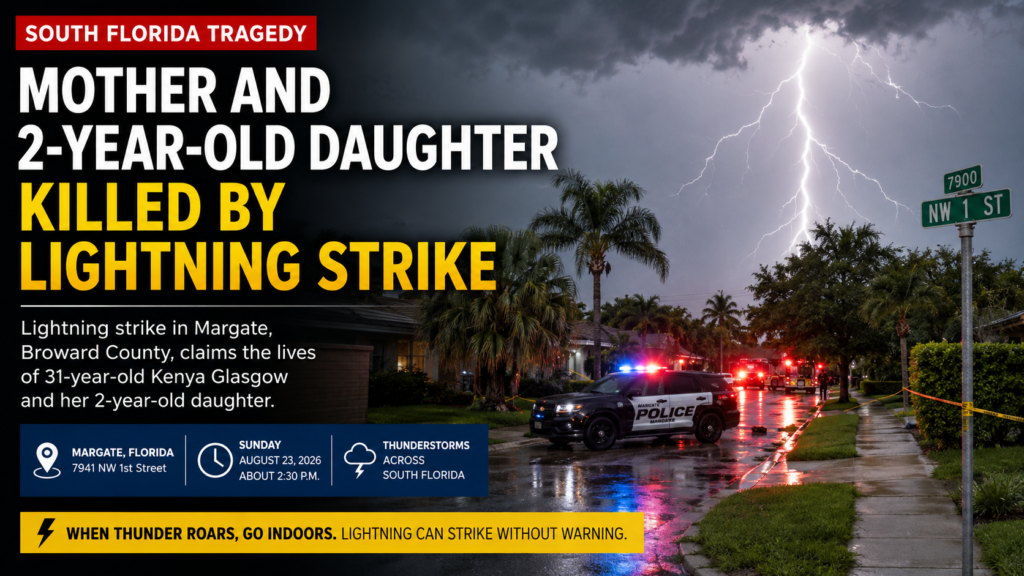
⚡ Mother and 2-Year-Old Daughter Killed by Lightning Strike in South Florida
MARGATE, Fla. — August 24, 2026 — A South Florida mother and her 2-year-old daughter were killed Sunday afternoon after being struck by lightning during thunderstorms in Broward County, authorities said.
The tragedy happened at approximately 2:30 p.m. Sunday, August 23, in the area of 7941 NW 1st Street in Margate, northwest of Fort Lauderdale. Margate Police and Margate Fire Rescue responded to reports of two people who had been struck by lightning and were lying on a sidewalk. (CBS News)
Authorities identified the mother as 31-year-old Kenya Glasgow. Police confirmed the second victim was her 2-year-old daughter. Some initial reports incorrectly identified the child as a boy and gave a different age for the mother; those details were subsequently corrected by local news organizations after confirmation from investigators. (CBS News)
🚑 First Responders Attempted to Save Mother and Child
Police officers and firefighters immediately began lifesaving efforts, including CPR, after arriving at the scene.
Glasgow was transported to North Broward Medical Center in Deerfield Beach, while her daughter was rushed with a police escort to Broward Health Medical Center in Fort Lauderdale.
Despite efforts by first responders and hospital personnel, both mother and daughter were pronounced dead shortly after arriving at the hospitals. (wplg)
The Margate Police Department said the incident remains under investigation.
⚡ Witness Describes Powerful Lightning Strike
A nearby resident told CBS Miami that he had just gotten his own family indoors when he heard an exceptionally loud thunderclap and saw an orange glow. After being alerted that someone may have been struck, he went outside and discovered the mother and toddler and attempted to help. (CBS News)
The incident occurred as thunderstorms moved across South Florida Sunday afternoon. (CBS News)
🌴 Tragedy Highlights Florida’s Lightning Danger
The deaths are a devastating reminder of the danger posed by thunderstorms in Florida.
Lightning does not require a hurricane, tornado or severe thunderstorm warning to become deadly. The National Weather Service emphasizes that people participating in outdoor activities should move to a safe location when thunderstorms threaten. Historically, a large share of U.S. lightning deaths have occurred during outdoor recreational activities. (National Weather Service)
The CDC says approximately 37 million lightning strikes reach the ground in the United States each year. While the annual odds of an individual being struck are less than one in a million, lightning remains capable of causing severe injury or death. (CDC)
Florida has long been one of the country’s major lightning hotspots. The National Weather Service’s Melbourne office describes Florida as the nation’s “Lightning Capital” and notes the state’s historically high number of lightning casualties. (National Weather Service)
⛈️ Lightning Safety: When Thunder Roars, Go Indoors
For residents and visitors across Marco Island, Naples, Collier County and the rest of Florida, afternoon thunderstorms should always be taken seriously.
If you can hear thunder, lightning is close enough to pose a danger.
During a thunderstorm:
🏠 Get inside a substantial building or hard-topped vehicle.
🏖️ Leave beaches, pools, golf courses and other exposed outdoor areas.
🌴 Do not shelter underneath an isolated tree.
🚤 Get off open water when thunderstorms approach.
⚡ Don’t wait for rain to begin before seeking shelter.
⏱️ Remain in a safe location until the thunderstorm has moved away.
Florida’s summer thunderstorms can develop rapidly, making it particularly important to keep an eye on weather conditions before spending extended periods outdoors.
❤️ Community Mourns Mother and Young Daughter
Margate Police expressed condolences to the victims’ family and loved ones following Sunday’s tragedy.
The deaths of a mother and her 2-year-old daughter serve as a heartbreaking reminder that lightning is one of Florida’s most unpredictable weather hazards — and every thunderstorm should be treated with caution.
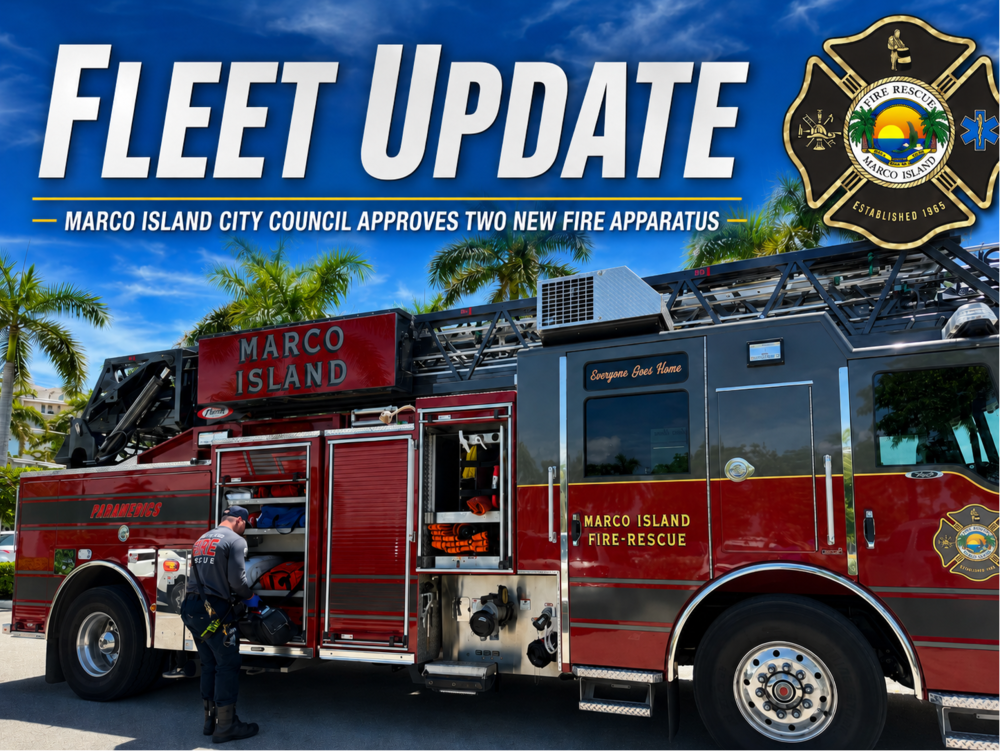
🚒 Marco Island Approves $3.5 Million Purchase of Two New Fire Trucks
New pumper and 100-foot tower truck will replace aging equipment in Marco Island Fire Rescue’s fleet
MARCO ISLAND, Fla. — August 20, 2026 — Marco Island firefighters will soon be getting some major new equipment after the City Council approved the purchase of two new fire apparatus totaling approximately $3.55 million.
The purchases are aimed at replacing aging fire trucks that city officials say have experienced increasing reliability problems, higher maintenance costs and excessive downtime.
The two new vehicles will include a Pierce Enforcer Pumper and a Pierce Enforcer 100-foot Ascendant Tower, significantly upgrading Marco Island Fire Rescue’s emergency response fleet.
🚒 New Pumper to Replace 2010 Fire Engine
The City approved approximately $1.03 million for a new Pierce Enforcer Pumper.
The truck will replace a 2010 fire engine currently operating in the department’s fleet.
As fire apparatus age, maintenance requirements and the amount of time vehicles spend out of service can increase — a particularly important concern for an island community where dependable emergency equipment needs to be ready when a call comes in.
City officials said replacing the older equipment should improve reliability and reduce the amount of time frontline apparatus are unavailable because of repairs or maintenance.
🪜 New 100-Foot Tower Truck Costs $2.52 Million
The larger investment is a new Pierce Enforcer 100-foot Ascendant Tower, approved at approximately $2.52 million.
The apparatus will replace Marco Island Fire Rescue’s existing ladder truck.
The 100-foot tower will provide firefighters with an elevated platform capable of reaching upper floors and elevated areas during fires, rescues and other emergencies — an important capability in a community with numerous condominiums, hotels and other multistory buildings.
Combined, the two purchases represent an investment of approximately $3.55 million in Marco Island’s fire and emergency response capabilities.
⏳ Don’t Expect to See Them at the Fire Station Tomorrow
City Council approval doesn’t mean the new trucks are about to roll onto Marco Island.
Fire apparatus of this size are highly specialized vehicles that must go through engineering, manufacturing, equipment installation, inspections and other steps before delivery.
Both vehicles will now enter the engineering and production process.
Marco Island Fire Rescue said it plans to keep residents updated as construction progresses, including sharing production photos and major milestones as the trucks move closer to completion.
No specific delivery date was announced in Thursday’s release.
🚨 Replacing Aging Equipment Before It Becomes a Bigger Problem
The City said the decision followed an evaluation of the existing fleet and concerns surrounding reliability, increasing maintenance expenses and excessive downtime.
For emergency services, an aging truck isn’t simply an inconvenience. When a primary apparatus is unavailable, departments may have to rely on reserve equipment or adjust how resources are deployed.
The City says the new purchases are part of a broader effort to maintain a dependable public-safety fleet while preparing for Marco Island’s long-term emergency response needs.
Once delivered, the new pumper and tower truck should give Marco Island Fire Rescue two major pieces of modern frontline equipment — and firefighters considerably fewer reasons to worry about whether an aging truck will be available when the next alarm comes in.
Marco Island Naples News will follow the progress of the new fire apparatus as they move through production and eventually make their way to Marco Island.