
Top 10 Historical Places in Collier County Worth Visiting
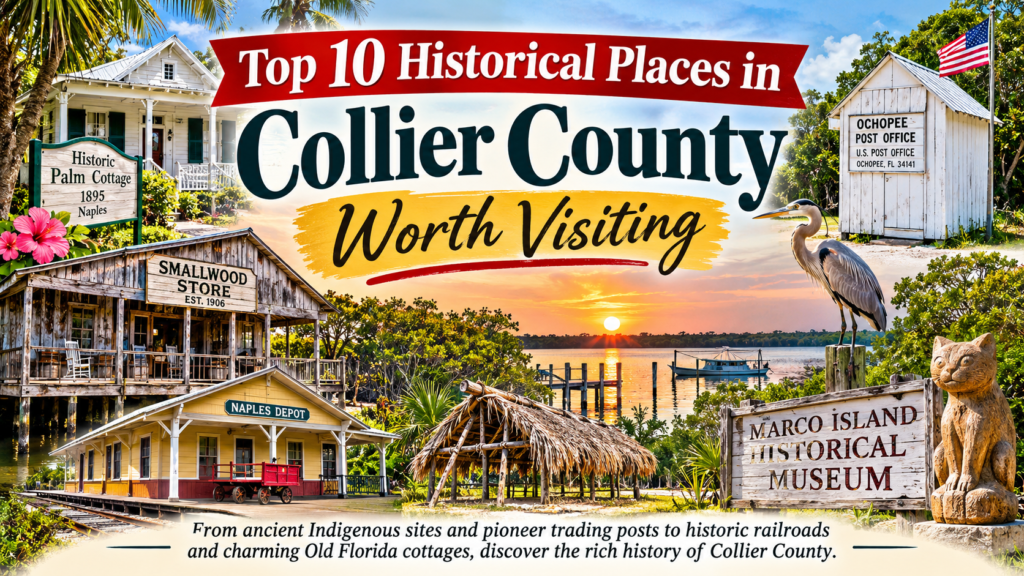



Top 10 Historical Places in Collier County Worth Visiting
MARCO ISLAND NAPLES NEWS | TRAVEL, HISTORY & LOCAL ATTRACTIONS
From ancient Indigenous civilizations and pioneer trading posts to historic railroad stations and charming Old Florida cottages, Collier County has a fascinating past waiting to be discovered.
Collier County is famous for its beautiful beaches, luxurious waterfront homes, championship golf courses and spectacular sunsets. But behind the modern resorts and million-dollar properties lies a history stretching back thousands of years.
Long before Naples became a fashionable winter destination, Indigenous communities lived along Southwest Florida’s coast, Seminole families traded throughout the Everglades, and determined pioneers established settlements in one of America’s most challenging environments.
Fortunately, many of these remarkable places have survived.
Whether you’re a history enthusiast, a longtime resident or a visitor looking for something beyond another afternoon at the beach, here are 10 historical places in Collier County worth exploring.
1. Historic Palm Cottage — Naples
137 12th Avenue South, Naples
Built in 1895, Historic Palm Cottage is Naples’ oldest surviving house and one of the city’s most treasured landmarks.
Operated by the Naples Historical Society, this beautifully preserved property offers visitors a fascinating glimpse into life before Naples became synonymous with luxury real estate and beachfront mansions.
Inside, guided tours introduce visitors to the families, architecture and early development of the community.
The cottage also provides an opportunity to explore Naples’ transformation from a remote coastal settlement into one of Florida’s most desirable destinations.
Why visit? It’s one of the best places to experience the atmosphere of Old Naples and understand how dramatically the city has changed over the past 130 years.
Visitor tip: Check the Naples Historical Society’s guided-tour schedule before visiting.
2. Marco Island Historical Museum — Marco Island
180 S Heathwood Dr, Marco Island, FL 34145, United States
Long before Marco Island had luxury condominiums, waterfront restaurants and busy tourist beaches, it was home to Indigenous communities whose remarkable history continues to fascinate archaeologists.
The Marco Island Historical Museum explores thousands of years of human occupation, including the Calusa and the extraordinary archaeological discoveries made at Key Marco.
One of the most famous discoveries is the Key Marco Cat, a small wooden carving that has become an internationally recognized symbol of the island’s ancient past.
Visitors can explore archaeological exhibits, historical displays and a recreated Indigenous village scene.
The museum also examines Marco Island’s later development, from fishing and farming to the modern resort community.
Why visit? It’s essential for anyone interested in the history of Marco Island and the people who lived here long before modern development.
Visitor tip: Admission is free.
3. Smallwood Store — Chokoloskee
Mamie Street, Chokoloskee
Few places capture the spirit of Old Florida quite like Smallwood Store.
Established in 1906 by pioneer Ted Smallwood, this historic trading post once served settlers, fishermen and Seminole customers living in the remote Ten Thousand Islands region.
Before modern roads connected the area to the rest of Florida, trading posts like this were vital to everyday life.
The wooden building stands on pilings overlooking the water, with its historic merchandise, artifacts and furnishings offering an extraordinary window into the past.
Walking through the store feels like stepping into a different century.
Why visit? The building, its contents and its waterfront setting offer one of Southwest Florida’s most authentic surviving pioneer experiences.
Visitor tip: Combine your visit with a drive through Everglades City and Chokoloskee. Check current admission and access before traveling.
4. Naples Depot Museum — Naples
1051 5th Ave S, Naples, FL 34102, United States
The arrival of the railroad helped transform Naples from a small coastal community into a growing Florida destination.
The historic Naples Depot recalls the railway boom of the 1920s, when improved transportation opened Southwest Florida to new residents, visitors and businesses.
Today, the restored railway station houses exhibits featuring historic transportation equipment, photographs and artifacts.
Visitors can discover how trains, boats, wagons and swamp buggies helped people travel through a region once considered difficult to reach.
The museum’s historic railway setting makes it especially appealing to families and transportation enthusiasts.
Why visit? It’s a fascinating reminder of how transportation helped shape modern Naples.
Visitor tip: The county museum offers free admission; the separately operated Naples Train Museum on the property has its own arrangements.
5. Museum of the Everglades — Everglades City
105 Broadway Ave W, Everglades City, FL 34139, United States
Everglades City has one of the most colorful histories of any community in Southwest Florida.
Once an important center of development and the original county seat of Collier County, this small waterfront town played a significant role in opening the Everglades to transportation and commerce.
The Museum of the Everglades occupies a restored building dating to 1927 that originally served as a commercial laundry.
Its exhibits explore Indigenous history, pioneer settlements, the construction of the Tamiami Trail and the ambitious projects associated with developer Barron Collier.
Historical photographs and artifacts reveal what life was like when much of the surrounding region remained isolated wilderness.
Why visit? It provides a compelling introduction to the people and projects that shaped the Everglades region.
Visitor tip: Admission is free, making it an excellent stop during an Everglades City day trip
6. Immokalee Pioneer Museum at Roberts Ranch — Immokalee
1215 Roberts Avenue West, Immokalee
Before Southwest Florida became a destination for tourists and retirees, cattle ranching and agriculture were central to the region’s economy.
The Immokalee Pioneer Museum at Roberts Ranch preserves this important chapter of Collier County’s history.
Originally the home of cattleman Robert Roberts and his family, the historic ranch features preserved buildings, exhibits and agricultural displays that illustrate everyday life during the early 1900s.
Visitors can explore the grounds and learn about the challenges faced by ranchers, farmers and pioneering families.
The property also features a restored garden and citrus grove, helping visitors understand the agricultural traditions that shaped Immokalee.
Why visit? It’s an excellent destination for discovering a side of Collier County that has little to do with beaches and luxury resorts.
Visitor tip: Allow time to explore the outdoor buildings and grounds. Admission is free.
7. Ochopee Post Office — Ochopee
U.S. Highway 41, Ochopee
One of Collier County’s smallest attractions also happens to be one of its most famous.
The Ochopee Post Office is recognized as the smallest functioning post office in the United States.
The tiny wooden structure was originally a storage shed for irrigation equipment on a tomato farm.
Following a devastating fire in 1953 that destroyed the community’s previous post office, the little shed was converted into a replacement.
More than seven decades later, it remains a memorable reminder of rural Florida’s past.
Although the building is tiny, its historical significance is considerably larger.
Why visit? It’s a quirky, memorable roadside attraction and a wonderful photography stop along the Tamiami Trail.
Visitor tip: The exterior is the main attraction. Postal counter hours may vary.
8. Olde Marco Inn — Marco Island
Old Marco Village, Marco Island
Marco Island’s history as a visitor destination began long before the arrival of modern beachfront resorts.
The historic Olde Marco Inn traces its origins to 1885, when Captain Bill Collier established the Marco Hotel to accommodate fishermen and travelers.
During the late 19th century, reaching Marco Island required considerably more determination than simply driving across a bridge.
The inn became an important gathering place for visitors and early settlers.
It also played a small but fascinating role in archaeological history.
In 1896, archaeologist Frank Hamilton Cushing used part of the hotel while working with ancient artifacts recovered during the famous Key Marco excavations.
Although the property has undergone changes over the years, its historic association with Marco Island’s earliest tourism remains significant.
Why visit? It’s an opportunity to explore the island’s original village area and appreciate the days when Marco was a remote fishing destination.
Visitor tip: Explore the surrounding Old Marco Village area. Confirm current public access to the historic inn property before visiting.
9. Collier Museum at Government Center — Naples
3331 Tamiami Trl E, Naples, FL 34112, United States
For anyone wanting to understand the complete history of Collier County, this museum is an excellent starting point.
Located on five acres of landscaped grounds, the Collier Museum at Government Center explores the region’s Indigenous heritage, pioneer settlement, transportation and community development.
Visitors can discover how people adapted to the challenges of living in Southwest Florida long before modern roads, air conditioning and extensive infrastructure.
Outdoor exhibits include historic equipment and structures, along with displays illustrating Seminole history and the region’s early industries.
The museum is particularly appealing to families because of its combination of indoor exhibits and outdoor attractions.
Why visit? It offers a broad introduction to Collier County’s history, making it ideal for newcomers and longtime residents alike.
Visitor tip: Admission is free. The museum grounds are also worth exploring.
10. Naples Historic District — Old Naples
Old Naples, near Third Street South and 12th Avenue South
Not every historical destination needs a museum ticket or a guided tour.
Sometimes, the best way to appreciate history is simply to walk through it.
The Naples Historic District preserves an important part of the city’s architectural and cultural heritage.
Visitors can explore streets lined with historic cottages, tropical landscaping and buildings that reflect Naples’ early development.
The neighborhood provides a fascinating contrast to the modern high-rise condominiums and luxurious estates found elsewhere along the coast.
A leisurely walk through Old Naples also makes it easy to combine history with shopping, dining and a visit to the nearby waterfront.
Why visit? It’s one of the most enjoyable ways to experience the charm and atmosphere of Naples before the modern development boom.
Visitor tip: Combine a walk around the historic district with a guided tour of Palm Cottage. Respect private residences while exploring
Which historical places are best for different visitors?
Interest | Best destination |
|---|---|
Ancient Indigenous history | Marco Island Historical Museum |
Old Florida atmosphere | Smallwood Store |
Historic architecture | Historic Palm Cottage |
Railroad history | Naples Depot Museum |
Pioneer and ranching history | Roberts Ranch |
Everglades history | Museum of the Everglades |
Unusual roadside attractions | Ochopee Post Office |
Family-friendly history | Collier Museum at Government Center |
Planning your historical adventure
One of the best things about exploring Collier County’s history is that many attractions are either free or relatively inexpensive.
All five county-operated museums offer free admission, making them particularly attractive for families and visitors looking for affordable activities.
Most are generally open Tuesday through Saturday, 9 a.m. to 4 p.m., although holidays, special events and maintenance can affect access.
For more information, visit Collier County Museums.
Final thoughts: Discover the Collier County that existed before the resorts
It’s easy to think of Collier County as a place defined by sunshine, beaches, waterfront homes and luxury living.
But the region’s history tells a much richer story.
From ancient coastal communities and Seminole trading traditions to pioneer ranches, railroad expansion and the construction of the Tamiami Trail, Southwest Florida has undergone an extraordinary transformation.
These 10 destinations help preserve that story.
And perhaps the most surprising discovery is just how much of Old Florida remains hidden in plain sight.
Because long before Collier County became paradise for visitors, it was home to generations of people whose ingenuity, resilience and traditions helped shape the region we know today.
Marco Island Naples News — Sometimes Funny, Sometimes Serious, Always Honest