Marco Island’s Gopher Tortoises Under Global Spotlight as Species Declared Critically Endangered
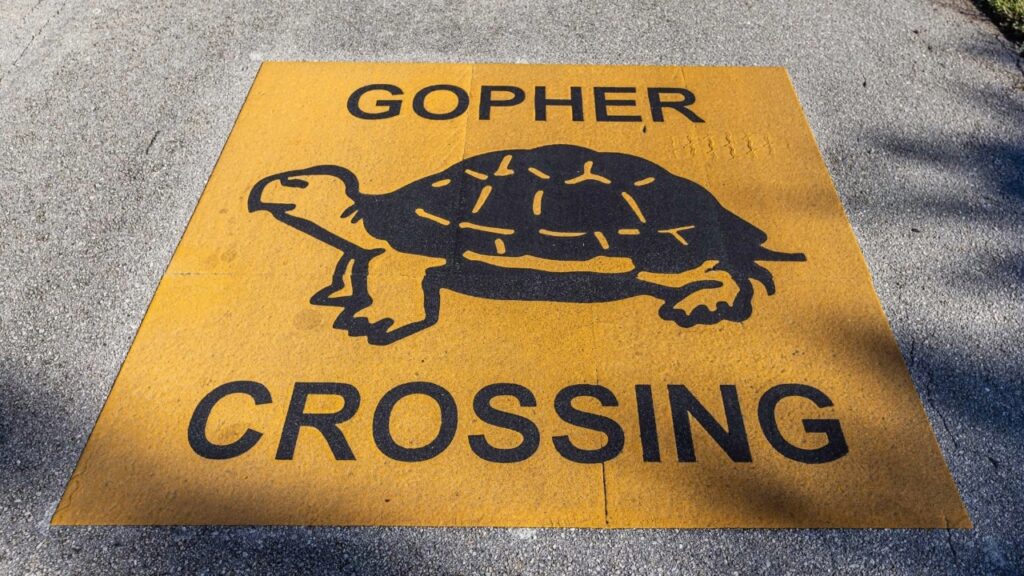
For years, Marco Island’s gopher tortoises have been a familiar sight—ambling across quiet streets, disappearing into sandy burrows on vacant lots, and occasionally bringing traffic to a patient halt.
Now, the reptile that has become one of the island’s best-known wild residents has found itself at the centre of an international conservation warning.
The International Union for Conservation of Nature (IUCN) has reclassified the gopher tortoise as Critically Endangered, citing decades of habitat destruction across the southeastern United States. It is one of the highest levels of extinction risk before a species is declared extinct in the wild.
For Marco Island, the announcement lands close to home.
Unlike many parts of Florida where development has already erased large areas of suitable habitat, Marco Island still supports one of Southwest Florida’s most visible urban populations. Tortoises continue to occupy vacant lots, roadside verges and patches of native vegetation, living alongside a community that has, for years, learned to share the island with them.
But every new home, every cleared lot and every additional road narrows the space available for a species that has occupied Florida’s sandy uplands for thousands of years.
Conservationists describe the gopher tortoise as a keystone species because its burrows provide refuge for more than 350 other animals—from burrowing owls and frogs to snakes, insects and the threatened eastern indigo snake. Protecting the tortoise means protecting an entire ecosystem hidden beneath the sand.
Marco Island has already become a focal point for those efforts.
The city, working alongside conservation groups including Audubon Western Everglades, has spent years mapping burrows, surveying tortoise populations and encouraging residents to report sightings. Educational campaigns remind homeowners that it is illegal to disturb occupied burrows and that construction projects often require wildlife permits before work can begin.
Yet the pressures continue.
Vacant lots that once provided ideal habitat are steadily disappearing as development fills in the remaining gaps. Roads divide populations, while vehicle strikes remain a persistent threat, particularly during the tortoises’ breeding season when they travel further in search of mates.
The new international designation does not automatically change legal protections in Florida. The species is already protected under state law, and developers must follow strict relocation rules before construction can proceed where tortoises are present.
But conservationists hope the IUCN’s assessment will strengthen the case for preserving what habitat remains.
For Marco Island residents, the slow-moving reptile is more than just another piece of Florida wildlife. It is part of the island’s identity—a reminder that even in one of the state’s most developed coastal communities, nature continues to endure.
Whether that remains true for future generations may depend on decisions made today, as Florida balances continued growth against the survival of one of its oldest native inhabitants.