
Indonesia Volcanoes and Live Eruptions This Week:
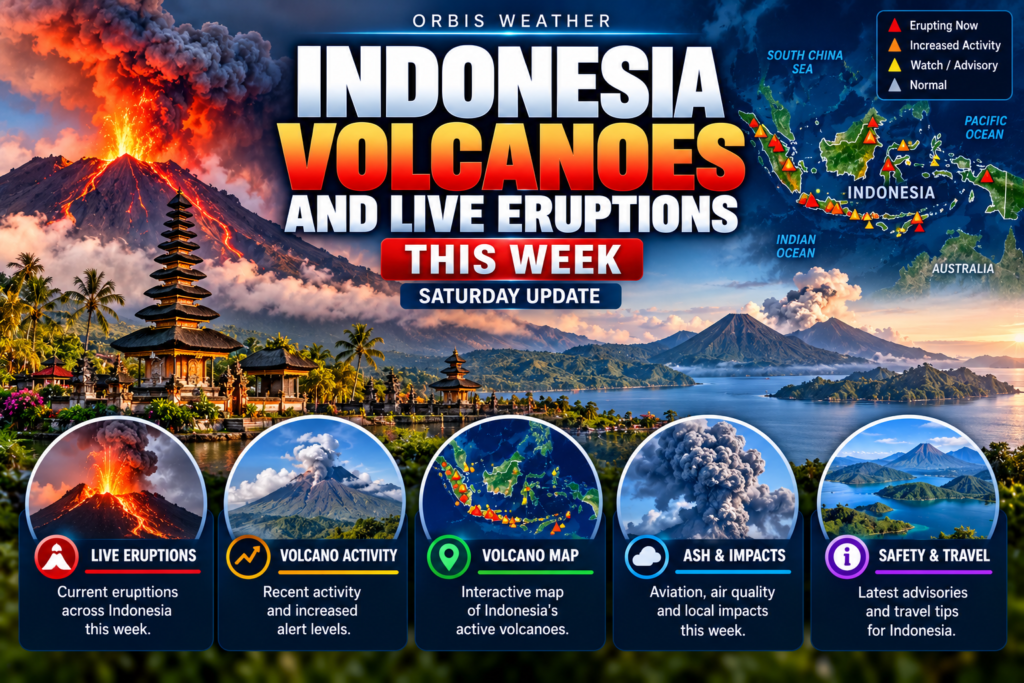
Indonesia Volcanoes and Live Eruptions This Week: November 7–13, 2026
Indonesia remains one of the world’s most volcanically active countries, with multiple volcanoes producing ash emissions, lava activity and continuing seismic unrest this week.
The latest Smithsonian/USGS weekly report identifies nine Indonesian volcanoes experiencing eruptive activity or renewed unrest, including Semeru, Merapi, Ibu and Karangetang.
🌋 Indonesia’s Volcano Activity This Week
Volcano | Location | Reported activity |
|---|---|---|
🌋 Semeru | East Java | Continuing eruptions and ash emissions |
🌋 Merapi | Central Java | Continuing eruptive activity |
🌋 Ibu | North Maluku | Eruptions and volcanic ash |
🌋 Dukono | North Maluku | Ash-producing eruptions |
🌋 Karangetang | North Sulawesi | Continuing eruptive activity |
🌋 Lewotolok | East Nusa Tenggara | Continuing eruptions |
🌋 Marapi | West Sumatra | Continuing eruptive activity |
🌋 Tengger Caldera | East Java | New eruptive activity |
🌋 Gamkonora | North Maluku | Newly reported volcanic unrest |
The Smithsonian/USGS report for November 5–11 confirms eight of these volcanoes; Singapore’s National Environment Agency separately recorded a Dukono eruption on November 13.
⚠️ Latest Eruption Reports
On November 13, Singapore’s National Environment Agency recorded fresh eruptions at Ibu, Semeru and Dukono, confirming that volcanic activity continued beyond the latest weekly Smithsonian reporting period.
Volcanic ash remains a concern for aviation, while pyroclastic flows, lava avalanches and rain-triggered volcanic mudflows can threaten communities near active volcanoes.
🔎 What to Watch Next
Semeru and Merapi remain important volcanoes to monitor because of their continuing activity and potential for hazardous flows. Authorities also continue monitoring volcanic activity across North Maluku, Sulawesi and the Lesser Sunda Islands.
Residents and visitors should follow official exclusion zones and the latest guidance from Indonesia’s volcanology agency, PVMBG.