Alligator Alcatraz Era Officially Ends as Miami-Dade Takes Back Remote Everglades Airport
OCHOPEE, Fla. — Almost exactly a year after it opened, the state-run immigration detention facility known as “Alligator Alcatraz” has closed for good — and Miami-Dade County is now moving to make sure nothing like it returns to the remote Everglades airstrip where it stood.
Gov. Ron DeSantis confirmed the closure at a June 25 news conference held at the site itself, appearing alongside White House border czar Tom Homan and Florida State Board of Immigration Enforcement Executive Director Anthony Coker. “It served its purpose for the time,” DeSantis told reporters, framing the facility as a temporary bridge until more permanent ICE detention capacity came online elsewhere. He said the final detainees had already left the site the week before, either transferred to other facilities or deported, with officials citing safety concerns tied to the start of the 2026 Atlantic hurricane season. DeSantis said the facility would be fully shut down within seven to fourteen days of the announcement.
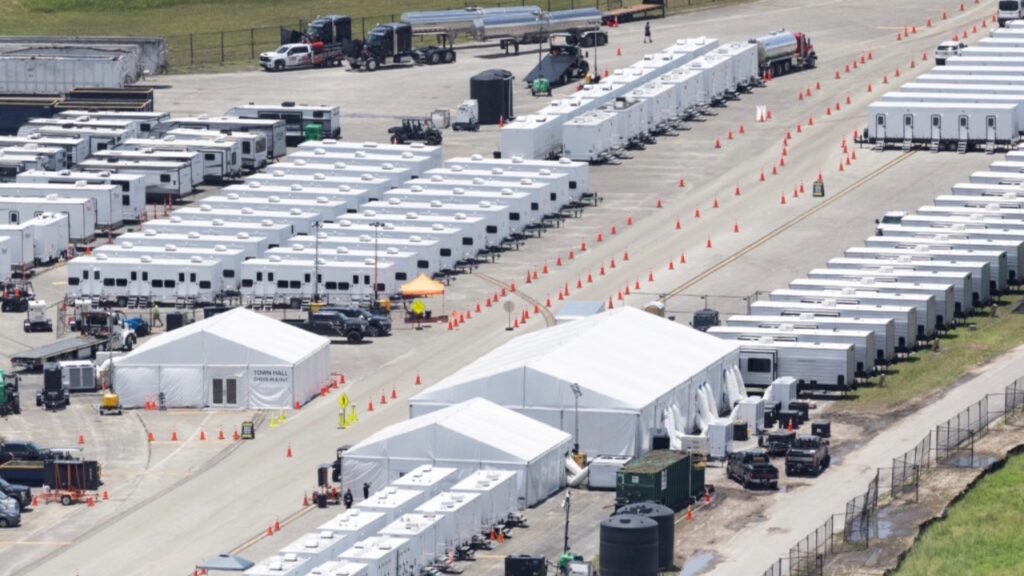
The facility — officially the South Florida Detention Facility, built on the Dade-Collier Training and Transition Airport inside Big Cypress National Preserve — opened on July 1, 2025, with President Trump touring the site on opening day. Built in just eight days at a cost the state has put at roughly $1.2 billion over its lifespan, it was designed to hold up to several thousand detainees at a time in a tent-and-trailer complex on an isolated single runway about 40 miles west of downtown Miami, near the Collier County line. DeSantis said Thursday that some 21,000 people passed through the facility over the course of its operation.
A year of controversy
Few Florida public-safety facilities have drawn as much national scrutiny. Civil liberties groups, immigration attorneys and members of Congress from both parties raised concerns almost from the start about detainees’ access to counsel and due process. Detainees and their families described overcrowded, unsanitary conditions — including reports of insect-infested food and sewage backups — that the Florida Division of Emergency Management repeatedly denied. In December 2025, Amnesty International published a report concluding that practices at the facility, including prolonged shackling and the use of a small isolation enclosure detainees called “the box,” constituted torture under international law.
The site also became a flashpoint over land use and tribal rights. The Miccosukee Tribe of Indians, whose traditional villages and burial grounds sit within Big Cypress, joined environmental groups including Friends of the Everglades and the Center for Biological Diversity in federal litigation arguing the facility was built without the environmental review required for a project of its scale, threatening habitat for the endangered Florida panther and Florida bonneted bat. A federal judge briefly ordered construction halted and the site wound down in August 2025 before an appeals court allowed operations to continue. Florida officials maintained throughout that the facility met all applicable standards and that detainees held there were subject to removal proceedings.
What happens to the land now
The bigger fight may be just beginning — over what becomes of the airstrip itself. Hours after DeSantis’s announcement, Miami-Dade Mayor Daniella Levine Cava sent county commissioners a memo proposing to sell or transfer the county-owned airport parcel to the National Park Service and other Everglades restoration partners, arguing the site is “fundamentally inconsistent with Miami-Dade County’s longstanding commitments to environmental stewardship” and no longer justifies the cost of county ownership. Levine Cava had rebuffed a state offer to buy the land for $20 million back in June 2025. Her goal now is to fold the property into the Comprehensive Everglades Restoration Plan, the decades-long, $23 billion effort to restore natural water flow through the region.
DeSantis pushed back on the idea at the same press conference, saying the state has looked at the question before and concluded that removing the airstrip “really wouldn’t make a huge impact” on restoration efforts while proving costly. “It was fine the way it was,” he said, noting the strip continues to be used for pilot training flights and expects that to continue.
The land carries its own long history of this exact fight. First cleared in 1968 as the start of a planned regional “jetport,” the project was stopped in 1970 after opposition from conservationist Marjory Stoneman Douglas and Native American leaders including Miccosukee elder Buffalo Tiger, leaving behind the single runway that stood empty for decades until last summer. Big Cypress became a national preserve in 1974, surrounding the county-owned airstrip on nearly all sides.
For Collier County residents, the outcome matters close to home — the site sits just across the county line from eastern Collier, along the same stretch of Tamiami Trail that connects Naples and Marco Island to the Everglades and Miccosukee tribal lands. Whether the airstrip becomes protected wetland or stays in county hands as a training facility will likely be decided by Miami-Dade commissioners in the months ahead.