MARCO ISLAND NAPLES NEWS
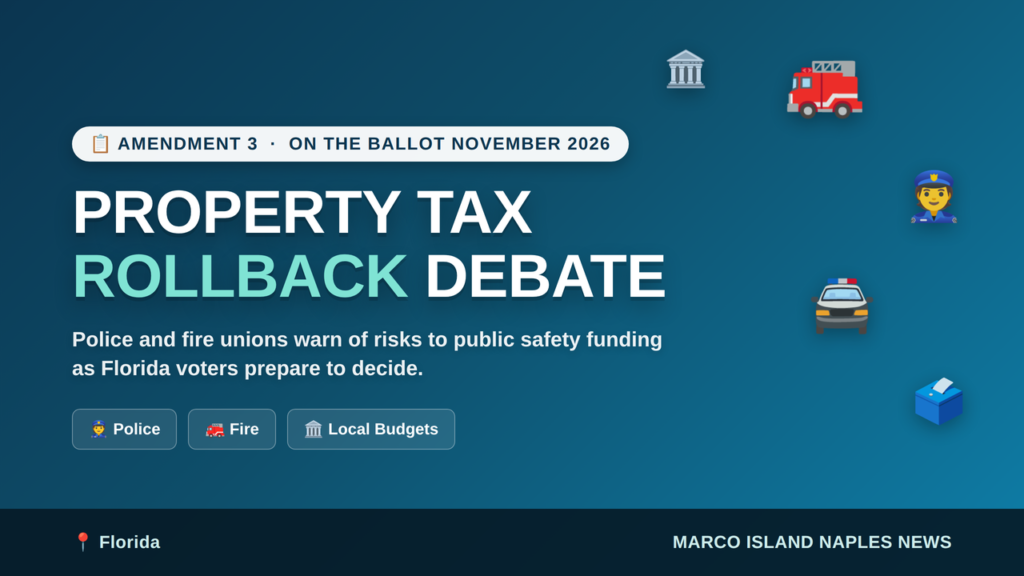
Florida Police and Fire Unions Oppose Property Tax Rollback, Warn of Risks to Public Safety
Amendment 3 heads to a November vote as law enforcement, fire officials and local leaders clash with supporters over how — or whether — lost revenue gets replaced
Florida voters will decide in November whether to dramatically cut the property taxes that fund much of local government — and police and fire unions across the state are lining up against the measure, warning it could gut the budgets that keep patrol cars staffed, fire trucks running and jail cells safely supervised.
The measure, known as Amendment 3 or “Save Our Homes From Excessive Property Taxes,” would raise the homestead exemption on a primary residence from $50,000 to $150,000 in 2027 and to $250,000 in 2028, while cutting the annual cap on assessment increases for non-homestead properties from 10 percent to 5 percent. School district property taxes are excluded from the changes. It needs 60 percent voter approval to become part of the state constitution.
Unions and Public Safety Officials Sound the Alarm
The Florida Fire Chiefs’ Association formally came out against the amendment on July 9, saying it lacks a credible plan to replace the revenue local governments would lose. “Tax relief and reliable emergency services are not mutually exclusive, but both require responsible long-term planning,” the association said in its statement, adding it could not support the measure “unless state leaders develop a comprehensive funding plan that preserves local governments’ ability to maintain these essential services” — citing fire protection, emergency medical response, and disaster preparedness specifically.
In Jacksonville, fire union president Kelly Dobson put the stakes in blunt budgetary terms: “Public safety here in Jacksonville between us and JSO takes up about 99% of that tax collection; that’s our budget,” he said, warning the amendment “will materially affect the way local governments will provide services and collect revenue.” Jacksonville’s mayor’s office echoed the concern in a statement: “Property tax revenue barely covers Jacksonville’s police and fire costs. Eliminating or dramatically changing this funding source will hurt public safety efforts.”
St. Johns County’s fire union said county leaders are already discussing alternative revenue sources in anticipation of the measure passing, while leaders in Clay County warned of reduced funding for everyday services and fewer choices for local governments generally.
The corrections side of public safety has raised similar alarms. Louis Quinones, chief of the Orange County Corrections Department — which is seeking a $228 million budget for fiscal year 2027, a 5 percent increase — told officials that potential staffing reductions or hiring freezes stemming from lost revenue would “increase the risk to public safety.” He warned that shrinking jail capacity could lead to overcrowding, and that budget cuts could eliminate crisis intervention training for staff — training he called critical given that more than 45 percent of the county’s jail population has a diagnosed mental health condition. He also flagged possible risks to the jail’s accreditation status.
The formal “Vote No on 3” opposition campaign has amplified those concerns. “Without a plan to backfill lost revenue, crippling cuts to critical services like fire protection are in Florida’s future,” said campaign spokesperson Edie Ousley. The campaign contends the amendment’s costs could eventually reach $34 billion pulled out of local government budgets statewide, and argues it would push up rents and costs for renters, first-time buyers and small businesses facing higher commercial property taxes. The Florida Democratic Party has also voted to formally oppose the amendment.
Supporters Say Homeowners Need Relief
Proponents counter that Florida homeowners are being squeezed by property tax bills that have grown far faster than incomes. Gov. Ron DeSantis, who pushed the Legislature to act in a special session, has cited state figures showing property tax revenue collected by local governments has nearly doubled in seven years — from about $32 billion to $60 billion — with projections reaching $83 billion by 2032. “Florida homeowners need relief,” DeSantis said. “Now is the time to stand up for taxpayers, enact a historic reform, and save the home of every Floridian.”
Notably, DeSantis has also distanced himself from the specific measure now headed to voters, saying “what the Legislature did wasn’t my proposal.” His original plan called for an immediate jump to a $250,000 exemption with a path toward eliminating homestead property taxes entirely, without carving out school district levies the way the Legislature’s version does. The dynamic has left Florida’s property tax debate with competing visions even among supporters of cutting taxes broadly — the disagreement is less about whether to cut, and more about how much, how fast, and what replaces the revenue.
What’s at Stake Locally
Property taxes fund the bulk of most Florida cities’ and counties’ police, fire and sheriff’s budgets — including here in Southwest Florida, where county government, the Sheriff’s Office and local fire districts all draw heavily on the same homestead tax base the amendment would shrink. Whatever voters decide in November, local governments across the state — not just Jacksonville, Orange and Clay counties — will be working out how to absorb the change, or how to replace the revenue, in the years that follow.
Estimates of the amendment’s fiscal impact vary by source: figures cited in testimony to state officials put the local government revenue loss at roughly $5 billion annually at first, growing to about $10.75 billion by 2031, while the Vote No on 3 campaign’s broader, cumulative estimate runs as high as $34 billion. The amendment goes before voters on the November 2026 ballot.
This report presents positions from both supporters and opponents of Amendment 3 based on public statements, official testimony and campaign materials. Marco Island Naples News takes no position on the amendment.
Sources: News4JAX, The Capitolist, Orlando Weekly, CBS Miami, WFLA, Florida Governor’s Office, Florida Phoenix